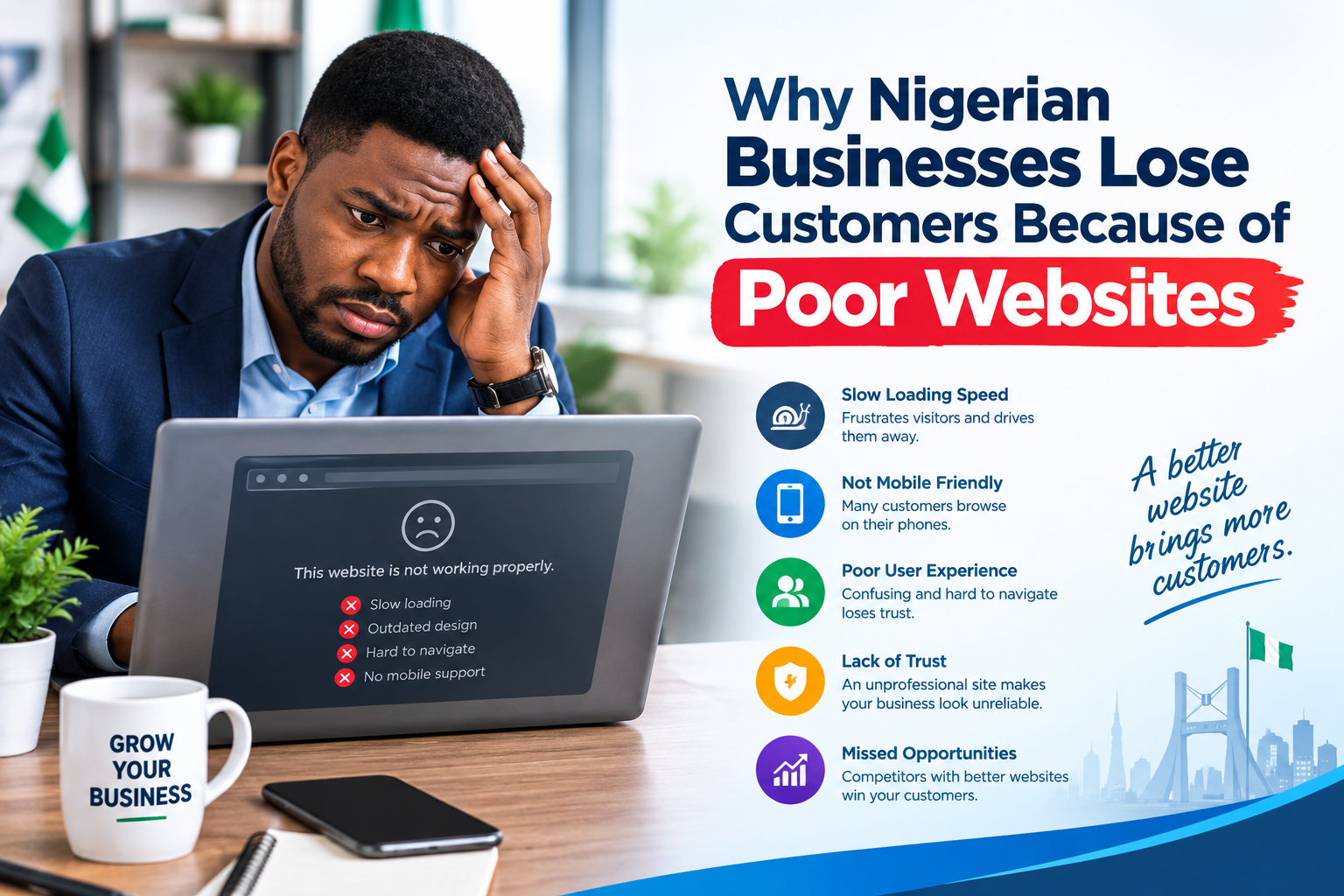
Why Nigerian Businesses Lose Customers Because of Poor Websites
Introduction
Your website may be the first place a potential customer encounters your business.
Before calling you, visiting your office, sending a WhatsApp message, placing an order or subscribing to your service, many customers will search for your business online.
Read also: Website vs Social Media: Why Your Business Needs Both
But what happens when they find a website that loads slowly, looks outdated, is difficult to navigate, does not work properly on a smartphone or fails to clearly explain what the business offers?
They may simply leave.
For Nigerian businesses, bloggers, content creators and news publishers, a poor website can mean more than an unattractive online presence. It can result in lost customers, fewer enquiries, lower advertising revenue, reduced credibility and missed business opportunities.
The problem is particularly important because Nigerians increasingly use smartphones to access websites, social media, online services, news platforms and business information.
A website therefore needs to do more than simply exist.
It needs to load quickly, work properly, provide useful information, build trust and make it easy for visitors to take action.
In this article, we will examine why Nigerian businesses lose customers because of poor websites, the most common website problems that drive visitors away, and what businesses, bloggers and publishers can do to improve their websites.
Why Does a Poor Website Cause Businesses to Lose Customers?
A website is often part of the customer’s decision-making process.
Imagine someone searches Google for a service in Nigeria and discovers two businesses offering similar services.
The first website loads quickly, works perfectly on a smartphone, displays clear contact information and explains its services professionally.
The second website takes a long time to load, contains broken links, has outdated information and makes it difficult to find a phone number.
Even if both businesses provide excellent services, the website experience can influence which business the customer contacts.
This is why website quality matters.
A poor website can create several problems, including:
- Loss of potential customers
- Fewer enquiries
- Lower conversion rates
- Reduced credibility
- Poor Google visibility
- High bounce rates
- Lower advertising revenue
- Reduced repeat visits
- Poor brand perception
- Missed sales opportunities
For news publishers and bloggers, the consequences can also include fewer page views, lower reader engagement and reduced opportunities for advertising and sponsored content.
15 Reasons Nigerian Businesses Lose Customers Because of Poor Websites
1. The Website Loads Too Slowly
Website speed is one of the biggest problems affecting online businesses.
A visitor who clicks your website expects the page to load quickly. If they have to wait several seconds before seeing useful content, they may return to Google and visit another website.
Slow websites can be caused by:
- Cheap or overloaded hosting
- Large image files
- Too many plugins
- Poorly coded themes
- Excessive JavaScript
- Unoptimized databases
- Too many advertisements
- Poor caching
- Outdated website software
- Lack of performance optimization
For Nigerian businesses and publishers, website speed is particularly important because visitors may access websites through different mobile networks and varying internet speeds.
What can you do?
Optimize images, use caching, reduce unnecessary scripts and plugins, choose appropriate hosting and regularly monitor website performance.
2. The Website Is Not Mobile-Friendly
A large percentage of website visitors access the internet using smartphones.
If your website was designed primarily for desktop computers, mobile visitors may experience:
- Tiny text
- Horizontal scrolling
- Buttons that are difficult to click
- Menus that do not work
- Images that extend beyond the screen
- Forms that are difficult to complete
- Poorly arranged content
This can quickly frustrate visitors.
A professional Nigerian business website should use responsive web design, meaning that the website automatically adapts to smartphones, tablets and desktop screens.
For bloggers and news publishers
Mobile responsiveness is even more important because readers frequently consume news and articles from their phones.
If reading your article becomes uncomfortable, visitors may leave before reaching the end.
3. Poor Website Design Makes the Business Look Unprofessional
Your website is part of your brand identity.
An outdated website can create the impression that the business itself is outdated.
For example, a website containing:
- Old graphics
- Poor typography
- Too many colors
- Broken layouts
- Low-quality images
- Flashing advertisements
- Confusing menus
- Inconsistent branding
can make visitors question the professionalism of the company.
This does not necessarily mean the business provides poor services.
However, customers often judge what they can see before they experience what you provide.
A clean, modern and professional website can help communicate credibility.
4. Customers Cannot Quickly Understand What You Offer
One of the biggest website mistakes is making visitors work too hard to understand the business.
When someone visits your homepage, they should be able to quickly understand:
Who are you?
What do you offer?
Who do you serve?
Why should they choose you?
How can they contact you?
If visitors have to search through several pages to discover what the business actually does, some will simply leave.
A good homepage should communicate the value proposition clearly.
For example:
“Professional Website Design and Mobile App Development for Nigerian Businesses.”
This is much clearer than a vague headline such as:
“Welcome to Our Website.”
5. Poor Navigation Frustrates Visitors
Website navigation should make it easy for visitors to find information.
Important pages should normally be easy to access, such as:
- Home
- About Us
- Services
- Products
- Blog/News
- Contact
- Privacy Policy
- Terms and Conditions
A complicated menu can frustrate users.
News publishers should also organize content using clear categories so readers can easily discover related stories.
For example:
Politics | Business | Technology | Sports | Entertainment | Health | World News
Clear navigation improves the overall user experience.
6. Missing or Difficult-to-Find Contact Information
Imagine a potential customer is ready to hire your company but cannot find your phone number.
Or they want to send a WhatsApp message but your website provides no contact option.
That is a lost opportunity.
Businesses should make contact information easy to find.
Depending on the nature of the business, this could include:
- Telephone number
- Email address
- Office address
- Contact form
- Social media links
- Google Maps location
A Call Now, Chat on WhatsApp, Request a Quote or Contact Us button can also make it easier for visitors to take action.
7. The Website Contains Outdated Information
Nothing reduces trust faster than outdated business information.
Imagine visiting a company’s website and discovering:
“Our latest news – 2021”
while the current year is 2026.

Or the website lists an old telephone number.
Or it advertises services that the company stopped offering years ago.
Visitors may wonder whether the business is still operating.
Businesses should periodically review their websites and update:
- Contact information
- Services
- Prices where applicable
- Company information
- Team information
- Blog posts
- News
- Copyright information
- Opening hours
- Social media links
8. Broken Links and Missing Pages
Broken links create a poor user experience.
Visitors may click:
“Learn More”
only to receive a 404 – Page Not Found error.
This can happen because pages were deleted, URLs were changed or website migrations were not properly handled.
Broken links can also interfere with search-engine crawling and website maintenance.
Website owners should periodically check for broken links and redirect important old URLs when necessary.
9. Poor Website Content Drives Visitors Away
A beautiful website cannot compensate for poor content.
Visitors want useful answers.
For businesses, website content should clearly explain:
- What the business does
- Products and services
- Benefits
- Frequently asked questions
- Pricing information where appropriate
- Contact options
- Location
- Company experience
- Relevant case studies or testimonials
For bloggers and publishers, content should be:
- Original
- Useful
- Easy to read
- Well structured
- Accurate
- Regularly updated
- Relevant to the target audience
Avoid publishing content simply because you want to fill the website.
Publish content because it provides value.
10. Poor SEO Makes the Website Difficult to Find
You may have an excellent website, but if potential customers cannot find it on Google, you may still lose business.
Search engine optimization helps search engines understand your website and its content.
Important SEO elements include:
- Search-intent-focused content
- Relevant keywords
- Descriptive page titles
- Meta descriptions
- Proper headings
- Internal linking
- Image optimization
- Mobile friendliness
- Technical SEO
- Fast loading pages
- Structured data where appropriate
- Quality backlinks
For Nigerian businesses, SEO can help attract people searching for relevant products and services.
For example, a web development company may create useful content around searches such as:
“web design company in Nigeria”
“how much does a website cost in Nigeria”
“how to build a business website in Nigeria”
The goal should not simply be to insert keywords repeatedly.
Read also: How a Small Business Can Get Customers From Google Without Ads
The content should genuinely answer the searcher’s question.
11. Too Many Pop-Ups and Advertisements
Advertising can be an important source of revenue for publishers.
However, excessive advertisements can damage the user experience.
Imagine opening a news article and immediately seeing:
- A full-screen popup
- Several banner advertisements
- An autoplay video
- Multiple notification requests
- Another popup asking for an email address
before you can even read the article.
The visitor may simply close the website.
Publishers should balance monetization with usability.
Advertising should generate revenue without making the website difficult to use.
12. No Clear Call to Action
A website should guide visitors toward an appropriate next step.
This is known as a Call to Action (CTA).
Examples include:
- Contact Us
- Get a Quote
- Call Now
- Chat on WhatsApp
- Buy Now
- Subscribe
- Download
- Book a Consultation
- Read More
Without a clear CTA, visitors may read your content and leave without taking action.
For businesses, this can mean lost leads.
For publishers, it may mean fewer newsletter subscribers, returning readers or social-media followers.
13. The Website Does Not Build Trust
People are understandably careful when dealing with businesses online.
A website should provide signals that help visitors understand who operates the business.
Depending on the organization, trust-building elements can include:
- Company information
- Physical address
- Telephone number
- Professional email
- Testimonials
- Client portfolio
- Case studies
- Certifications
- Business registration information where appropriate
- Privacy policy
- Terms and conditions
- Secure HTTPS connection
- Active social media profiles
For Nigerian businesses seeking customers online, these details can make it easier for potential customers to verify the business.
14. Poor Website Security Can Damage Customer Confidence
Website security is not only a technical issue.
It can also affect trust.
Visitors may become concerned if their browser displays security warnings or if a website has been compromised.
Website owners should therefore maintain:
- SSL/HTTPS
- Updated WordPress core
- Updated themes
- Updated plugins
- Strong administrator passwords
- Secure hosting
- Regular backups
- Malware monitoring
- Appropriate security controls
For WordPress websites, regularly updating plugins and themes is particularly important.
15. The Website Does Not Encourage Visitors to Return
Getting someone to visit your website once is useful.
Getting them to return is even more valuable.
Businesses and publishers can encourage repeat visits by publishing useful content regularly.
For example:
Businesses
Publish:
- Industry guides
- Tutorials
- Case studies
- Frequently asked questions
- Product updates
- Customer success stories
Bloggers
Publish:
- How-to guides
- Reviews
- Tutorials
- Opinion pieces
- Educational articles
- Resource lists
News Publishers
Publish:
- Breaking news
- Investigative reports
- Interviews
- Analysis
- Local stories
- Special reports
A website that consistently provides useful content can become a destination rather than just a digital business card.
How Poor Websites Affect Nigerian Content Creators and Bloggers
The problem is not limited to traditional businesses.
Content creators and bloggers also depend heavily on website quality.
A poor website can reduce:
Page views → Engagement → Returning visitors → Advertising opportunities → Revenue
For bloggers, the website itself is often the product.
If readers cannot comfortably consume the content, they have little reason to stay.
Bloggers should therefore pay attention to:
- Page speed
- Mobile design
- Typography
- Content structure
- Internal links
- Search functionality
- Related posts
- Advertising placement
- Social sharing
- Newsletter subscription
- SEO
How Poor Websites Affect Nigerian News Publishers
News websites face a particularly challenging environment.
Readers expect news websites to be fast and easy to navigate.
A news website should make it easy to discover:
- Latest news
- Breaking news
- Trending stories
- Categories
- Search
- Related stories
- Author information
- Videos
- Photo stories
News publishers should also avoid excessive advertising that makes reading difficult.
A well-structured news website can make it easier for visitors to discover multiple stories during the same session.
How Nigerian Businesses Can Improve Their Websites
Improving a website does not always require rebuilding everything from scratch.

Start with an audit.
Step 1: Test Your Website on a Smartphone
Open your website using different mobile devices.
Ask:
- Does it load quickly?
- Is the text readable?
- Are buttons easy to tap?
- Does the menu work?
- Can users easily contact the business?
Step 2: Check Website Speed
Test important pages and identify the elements slowing them down.
Look at:
- Images
- Plugins
- Scripts
- Hosting
- Caching
- Database performance
Step 3: Review Your Homepage
A visitor should understand your business quickly.
Make sure the homepage clearly communicates:
What you do + Who you serve + Why it matters + What visitors should do next.
Step 4: Improve Your Content
Review important pages and remove unnecessary information.
Make your content:
- Clear
- Concise
- Helpful
- Well structured
- Easy to scan
Use headings, bullet points, images and short paragraphs where appropriate.
Step 5: Make Contact Easy
Add prominent contact options.
For Nigerian customers, a WhatsApp button can be particularly useful where WhatsApp is part of the business’s normal customer-service workflow.
Step 6: Improve SEO
Create content around questions your customers actually search for.
Instead of publishing only promotional content, answer customer questions.
For example:
How much does website design cost in Nigeria?
How can a small business get customers from Google?
How do I improve my website’s Google ranking?
These topics can attract people who are actively looking for information related to your services.
Website Quality Checklist for Nigerian Businesses
Use this simple checklist to evaluate your website.
| Website Element | Check |
|---|---|
| Mobile responsive | ✓ |
| Fast loading | ✓ |
| HTTPS enabled | ✓ |
| Clear navigation | ✓ |
| Professional design | ✓ |
| Updated content | ✓ |
| Clear contact information | ✓ |
| WhatsApp/contact CTA | ✓ |
| SEO optimized | ✓ |
| Quality images | ✓ |
| No broken links | ✓ |
| Secure WordPress/plugins | ✓ |
| Clear calls to action | ✓ |
| Useful blog/content | ✓ |
| Regular backups | ✓ |
If several of these items are missing, your website may be creating unnecessary barriers for potential customers.
Frequently Asked Questions
Can a bad website really make a business lose customers?
Yes. A website that is slow, difficult to use, outdated, insecure or unclear can create friction during the customer’s decision-making process. Visitors may leave before contacting the business.
What makes a good business website?
A good business website should be fast, mobile-friendly, secure, easy to navigate, professionally designed and filled with useful information. It should also make it easy for visitors to contact the business or complete the intended action.
How important is mobile-friendly design in Nigeria?
It is very important because many Nigerians access online content and services using smartphones. Businesses should therefore ensure that their websites work properly across mobile devices.
Does website speed affect SEO?
Website performance is one of the factors that can contribute to a good user experience and search performance. Website owners should therefore pay attention to loading speed alongside other technical and content-related SEO factors.
How often should a business update its website?
There is no universal schedule. Businesses should update information whenever it changes and regularly review important pages, security, software, contact details and content to ensure that everything remains accurate and functional.
Should Nigerian businesses have a blog?
A blog can be useful when a business has genuinely helpful information to share. Educational articles can answer customer questions, demonstrate expertise and create additional opportunities to appear in relevant search results.
How much does it cost to build a professional website in Nigeria?
The cost varies considerably depending on the website type, number of pages, design requirements, functionality, hosting, integrations, content and maintenance requirements. A simple business website will generally require a different budget from a large e-commerce platform, news website or custom web application.
Final Thoughts
A website is no longer simply an online brochure.
For many Nigerian businesses, bloggers, content creators and news publishers, it is an important part of the customer and audience experience.
A slow website can lose visitors.
A confusing website can lose enquiries.
An outdated website can reduce trust.
Poor SEO can make a website difficult to discover.
And excessive advertising can drive readers away.
The good news is that many of these problems can be identified and fixed.
If your website is not generating the visitors, enquiries, customers or audience engagement you expect, the problem may not be your business.
Your website may be part of the problem.
Start by auditing your website’s speed, mobile experience, content, navigation, SEO, security and calls to action.
Small improvements across these areas can make the website more useful to the people you want to reach.
Need a Professional Website for Your Business?
At ENGRMKS & CO., we help businesses, content creators, bloggers and media organizations build professional websites designed around usability, performance, mobile responsiveness and search visibility.
Whether you need a new business website, WordPress website, news platform, blog, e-commerce website or custom web application, the right website can give your organization a stronger digital foundation.
Read also: How to Optimise News Headlines for Google Search
Ready to improve your online presence?
Contact ENGRMKS & CO. today to discuss your website project.