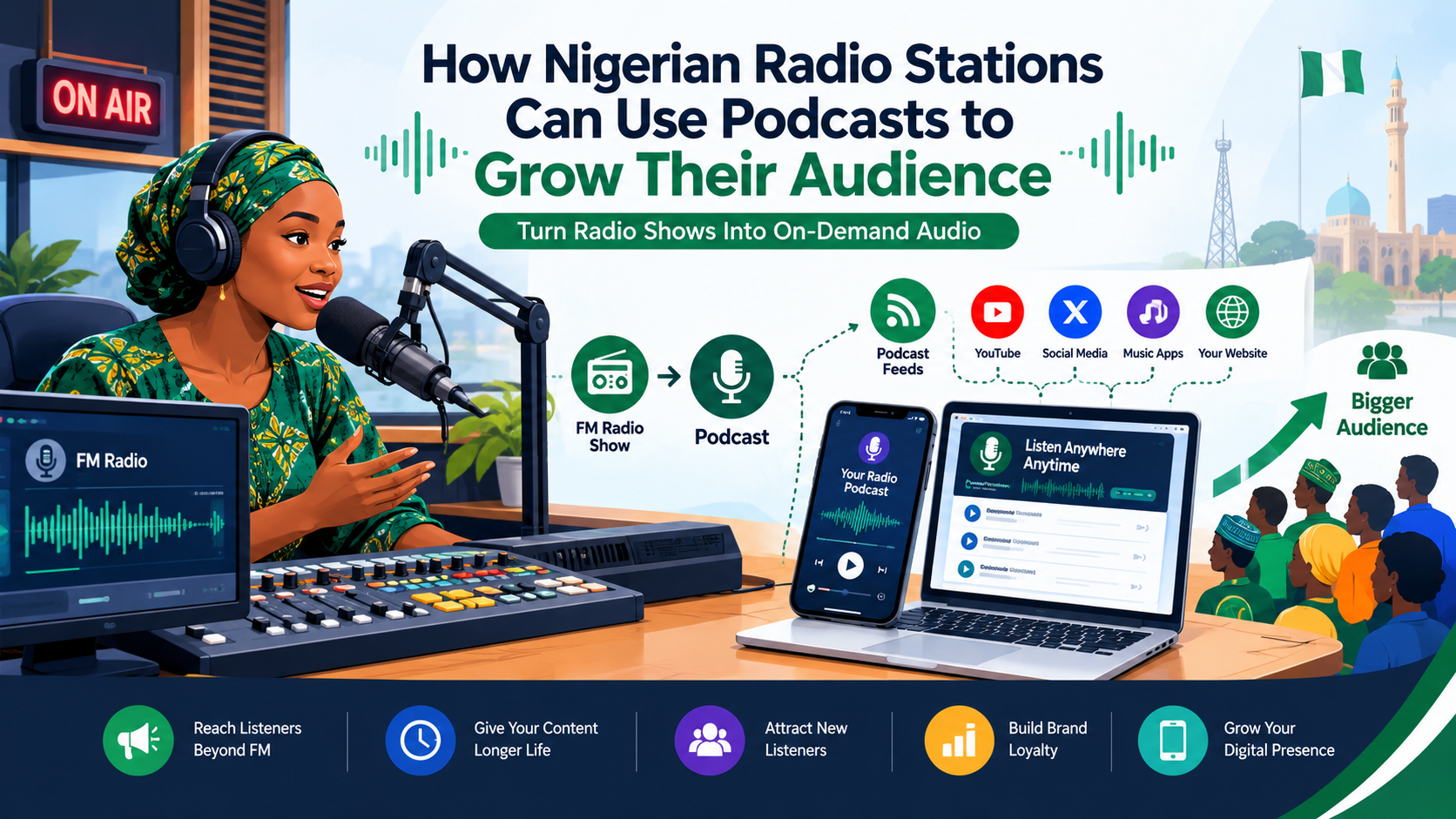
How Nigerian Radio Stations Can Use Podcasts to Grow Their Audience
Radio remains one of the most powerful forms of mass communication in Nigeria. From major cities to smaller communities, radio stations continue to inform, educate, entertain and connect with listeners every day.
But the way audiences consume audio is changing.
Read also: Why Every Radio and Media House in Nigeria Needs a Modern Website in 2026
People are no longer limited to listening to a programme at the exact time it is broadcast. With smartphones, mobile internet, streaming platforms and digital audio services, listeners can increasingly choose what they want to hear, when they want to hear it and where they want to hear it.
This creates an important opportunity for Nigerian radio stations:
Turn radio programmes into podcasts.
Podcasting does not have to compete with traditional FM broadcasting. Instead, it can extend the reach of radio content beyond the broadcast schedule.
A morning programme that lasts two hours on FM does not have to disappear when the programme ends. Selected segments, interviews, discussions and special features can continue attracting listeners online as podcast episodes.
For Nigerian radio stations looking to build a stronger digital audience, podcasting can become an important part of their content strategy.
What Is a Podcast?
A podcast is a digital audio programme that people can access and listen to on demand.
Unlike traditional radio, which usually follows a broadcast schedule, podcasts allow listeners to choose when to listen.
A podcast can contain:
- Interviews
- News analysis
- Educational programmes
- Sports discussions
- Business conversations
- Religious programmes
- Health discussions
- Entertainment
- Politics and public affairs
- Technology discussions
- Community stories
- Documentary-style audio
- Special radio programme segments
For radio stations, this means existing production capabilities can potentially be adapted for a digital audience.
Why Should Nigerian Radio Stations Consider Podcasting?
The biggest opportunity is simple:
Radio broadcasts reach people at a particular time. Podcasts allow content to remain available after the broadcast.
Consider a popular radio interview.
The interview may be broadcast at 10:00 a.m.
Listeners who are driving, working, attending school or otherwise unavailable at that time may miss it.
But if the interview is also published as a podcast, those listeners can potentially access it later.
The same content can therefore serve both the traditional radio audience and the on-demand audience.
1. Podcasts Can Extend the Life of Radio Content
Traditional radio content has a relatively short broadcast window.
Once a programme ends, the majority of listeners move on to the next programme.
Podcasting provides another option.
A station can preserve valuable content and make it available as individual episodes.
For example:
Radio Programme:
“Morning Talk”
The station could turn selected segments into:
- Morning Talk: Interview with Kano Business Expert
- Morning Talk: Health Questions from Listeners
- Morning Talk: Education Policy Discussion
- Morning Talk: Youth Employment Debate
Instead of treating the two-hour programme as one piece of content, the station can transform it into several digital assets.
This creates more opportunities for discovery.
2. Podcasts Can Reach Listeners Beyond the FM Coverage Area
A local FM station is generally associated with a particular broadcast area.
Digital distribution can potentially reach listeners far beyond that geographical footprint.
A radio station based in Kano could have listeners in:
- Kaduna
- Abuja
- Katsina
- Jigawa
- Bauchi
- Lagos
- other parts of Nigeria
- Nigerians living abroad
The station’s broadcast signal may not reach all these listeners, but its digital content can potentially reach them through internet-connected devices.
This is one of the major reasons radio stations should think beyond the transmitter.
3. Podcasts Can Help Attract Younger Digital Audiences
Younger audiences increasingly consume content through smartphones and digital platforms.
A radio station that publishes only scheduled FM programmes may miss opportunities to connect with people who prefer on-demand digital content.
Podcasting gives stations another format for reaching those audiences.
The content does not necessarily have to sound completely different from the station’s existing programming.
The station can simply adapt selected programmes into convenient, searchable and shareable digital episodes.
4. Radio Presenters Can Become Podcast Hosts
A radio station already has an important asset:
its presenters.
Popular presenters can potentially become the voices of podcast series.
For example:
A sports presenter could host:
The Weekend Sports Podcast
A business presenter could host:
Business & Markets Nigeria
A health programme could become:
Your Health Weekly
An entertainment presenter could host:
Entertainment Roundtable
This allows the station to build digital content around personalities that audiences already recognise.
5. Interviews Are Perfect for Podcast Content
One of the easiest places for a radio station to begin is with interviews.
Radio stations already interview:
- Government officials
- Business owners
- Doctors
- Lawyers
- Academics
- Community leaders
- Entrepreneurs
- Artists
- Religious scholars
- Sports personalities
- Civil society representatives
- Technology professionals
Instead of allowing the interview to disappear after the broadcast, the station can publish it as a podcast episode.
A 30-minute interview can become a valuable digital asset.
The station can also create a webpage containing:
- Episode title
- Short description
- Guest information
- Audio player
- Key discussion points
- Related articles
- Social media links
- Transcript or summary where appropriate
This creates additional opportunities for people to discover the programme online.
6. Podcasts Can Support Website Traffic
Radio stations should not think of podcasting as something that exists only on third-party audio platforms.
The station’s website should play an important role.
For example:
Podcast episode:
“How Small Businesses Can Access Funding in Nigeria”
The station can create a dedicated webpage containing the episode.
The page could include:
Title:
How Small Businesses Can Access Funding in Nigeria
Introduction:
A short summary of the discussion.
Audio:
Embedded podcast player.
Guest:
Name and professional background.
Key points:
Important issues discussed during the programme.
Related content:
Links to relevant articles and previous episodes.
This creates a searchable web page around the podcast.
Google’s Search Essentials recommend creating helpful, reliable, people-first content and using words people would use to find the content in prominent parts of a page.
7. Create SEO-Friendly Podcast Pages
A podcast episode should not simply be uploaded with a title such as:
Episode 15
That title tells potential listeners almost nothing.
Instead, use descriptive titles.
For example:
Weak:
Episode 15 – Radio Show
Better:
Kano Entrepreneurs Discuss How Small Businesses Can Access Funding
The second title provides context and gives search engines and users a much clearer idea of what the episode is about.
Each episode page can also include:
- A descriptive title
- A useful introduction
- Relevant keywords
- Guest name
- Location
- Date
- Audio player
- Transcript or summary
- Related links
- High-quality image
The goal should be to create a useful webpage, not merely a page containing an audio file.
8. Use Transcripts to Create More Searchable Content
Audio is excellent for listeners, but search engines need accessible text to understand the subject of a webpage.
A transcript can turn a podcast episode into a much richer content asset.
For example, a 40-minute interview with a business expert could produce:
Podcast:
40-minute audio interview.
Website article:
A summary of the interview.
Transcript:
Detailed text version.
Social media:
Several short quotes or clips.
Video:
Short video excerpts.
One interview can therefore become multiple pieces of content.
This is particularly useful for news and current-affairs radio stations.
9. Turn One Radio Programme Into Multiple Digital Content Pieces
A radio station does not necessarily need to create completely new content every day.
It can repurpose existing production.
For example:
One 60-minute programme
Can become:
- Full podcast episode
- Interview podcast
- Short news analysis
- Website article
- Social media quote
- Short video
- Audiogram
- WhatsApp-friendly clip
- Newsletter item
- Follow-up discussion
This is known as content repurposing.
It can help stations get more value from content they are already producing.
10. Use Social Media to Promote Podcast Episodes
Publishing a podcast is only the beginning.

The station should promote each episode.
A single episode can be promoted through:
For example:
New Podcast Episode:
How Can Young Nigerians Start Successful Businesses With Limited Capital?
Then provide a short introduction and direct listeners to the episode.
Short video clips can be particularly useful for promoting longer discussions.
A powerful quote from a guest can become a short social media video that encourages people to listen to the complete episode.
11. Consider YouTube as Part of the Podcast Strategy
Although podcasts are traditionally associated with audio, many audiences also consume podcast programmes through video platforms.
A radio station with cameras in its studio can potentially record selected interviews and discussions.
The same programme can then become:
- Radio broadcast
- Audio podcast
- YouTube video
- YouTube Shorts
- Facebook video
- Instagram Reel
- TikTok clip
- Website article
This creates a multimedia content ecosystem around one production.
The station does not necessarily need to record every programme.
It can start with its most suitable shows, interviews or special discussions.
12. Create Different Podcast Series for Different Audiences
A station does not have to operate one giant podcast.
Different programmes can target different interests.
For example:
News
The Daily News Brief
Short summaries of major stories.
Business
Nigeria Business Today
Conversations about entrepreneurship, markets and business.
Health
Healthy Nigeria
Medical discussions and public health education.
Sports
Sports Weekend
Football and other sports analysis.
Entertainment
Naija Entertainment Weekly
Music, film and entertainment discussions.
Community
Community Voices
Stories and issues affecting local communities.
This allows the station to build several content categories under one digital brand.
13. Consider Hausa and Other Nigerian Languages
Language can provide an important opportunity for Nigerian radio stations.
A station serving Northern Nigeria, for example, can create podcast content in Hausa alongside English-language programming.
This can include:
- Hausa news analysis
- Hausa interviews
- Agricultural programmes
- Health education
- Religious discussions
- Community programmes
- Youth discussions
- Educational content
The same principle can apply to stations serving audiences in other Nigerian languages.
Local-language podcasting can help stations develop content that is highly relevant to specific communities.
14. Make Podcasts Easy to Find
If listeners cannot find your podcast, audience growth becomes difficult.
The station should therefore maintain a consistent digital identity.
Use the same or closely related:
- Podcast name
- Station name
- Logo
- Presenter identity
- Episode naming system
- Website branding
- Social media branding
For example:
Station: XYZ Radio
Read also: Why Every Radio and Media House in Nigeria Needs a Modern Website in 2026
Podcast: XYZ Business Hour
Episode: How Nigerian SMEs Can Improve Their Online Sales
This makes the relationship between the station and podcast clear.
15. Publish Consistently
Consistency is more important than publishing a huge number of episodes and then stopping.
A station could begin with:
- One episode per week
- Two episodes per week
- Three short episodes per week
The schedule should match the station’s production capacity.
It is better to consistently publish useful episodes than to create a large catalogue and abandon it.
Create a publishing calendar containing:
- Episode title
- Presenter
- Guest
- Recording date
- Publication date
- Social media promotion
- Website page
- Follow-up content
This makes podcast production easier to manage.
16. Build a Strong Podcast Introduction
Every podcast should establish its identity.
A short introduction can mention:
- Station name
- Podcast name
- Presenter
- Episode subject
For example:
“You are listening to the XYZ Radio Business Podcast, bringing you practical conversations about business and entrepreneurship in Nigeria.”
Keep the introduction short.
Listeners generally want to get to the content quickly.
17. Keep Audio Quality Professional
A podcast does not require an expensive studio to sound good.
Radio stations already have an advantage because they typically possess microphones, mixers, recording systems and trained presenters.
However, podcast recordings should still be checked for:
- Background noise
- Distortion
- Excessive volume
- Very low volume
- Long silences
- Unnecessary sections
- Poor microphone positioning
Before publishing, listen to the final episode from beginning to end.
A professional-sounding recording improves the listening experience.
18. Give Every Episode a Good Description
Do not publish an episode with only:
“Listen to today’s programme.”
Instead, explain what listeners will hear.
For example:
“In this episode, we speak with Kano-based entrepreneur Ahmed Musa about the challenges facing small businesses, access to finance and practical strategies for attracting customers online.”
A useful description helps potential listeners decide whether the episode is relevant to them.
It also gives the webpage useful text.
19. Use Structured Data Where Appropriate
For stations publishing podcast episodes on their websites, structured data can help search engines better understand webpage content.
Google explains that structured data provides explicit clues about the meaning of a page and can make pages eligible for enhanced search appearances where supported. However, structured data does not guarantee that Google will display a rich result.
For a radio station’s podcast webpage, the broader SEO strategy should therefore include:
- Clear page titles
- Descriptive headings
- Useful written descriptions
- Accessible audio
- Appropriate structured data
- Internal links
- High-quality images
- Mobile-friendly design
Google’s current documentation also lists Article structured data among supported Search features for news, sports and blog articles.
The technical implementation should accurately reflect what is actually visible on the page.
20. Connect the Podcast to the Radio Station Website
A radio station should avoid creating a completely disconnected podcast presence.
The website can become the central hub.
For example:
Radio Website
→ Live Radio
→ News
→ Programmes
→ Podcasts
→ Presenters
→ Events
→ Advertise
→ Contact
The podcast section can then contain all episodes.
This gives visitors a clear path between the station’s traditional broadcasting service and its digital content.
21. Use Podcasting to Attract Advertisers
Podcasting can also create additional commercial opportunities.
Traditional radio advertising typically involves:
- Sponsored programmes
- Commercial spots
- Jingles
- Mentions
- Outside broadcasts
Podcasting can introduce additional formats, subject to applicable advertising rules and audience fit.
Examples include:
- Episode sponsorship
- Presenter-read sponsorship messages
- Sponsored podcast series
- Branded interviews
- Business-focused programmes
- Sponsored educational series
For example:
“The XYZ Business Podcast is brought to you by ABC Microfinance.”
The station should clearly distinguish sponsored content from editorial content and maintain appropriate disclosure practices.
22. Build a Podcast Sponsorship Package
Radio stations can create a dedicated podcast advertising package.
For example:
Basic Package
- Sponsor mention
- Logo on episode page
- Social media promotion
Standard Package
- Sponsor mention
- Branded episode
- Website placement
- Social media promotion
- Short sponsor message
Premium Package
- Dedicated podcast series
- Multiple episodes
- Website promotion
- Social media campaign
- Video clips
- Sponsor branding
The exact pricing will depend on the station’s audience, production costs and commercial strategy.
The important point is that podcasting can become part of the station’s broader digital advertising inventory.
23. Measure Podcast Performance
Radio stations are used to measuring audience performance, and podcasting should be approached in the same way.
Track metrics such as:
- Number of episodes published
- Downloads or plays
- Average listening duration where available
- Website visits
- Traffic sources
- Social media engagement
- Subscriber or follower growth
- Popular episodes
- Popular topics
- Audience locations
- Conversion or enquiry activity
The goal is not simply to produce podcasts.
The goal is to understand what audiences actually want.
If interviews about entrepreneurship consistently outperform generic discussions, the station may decide to produce more entrepreneurship content.
If short news briefings perform better than long discussions, the station can experiment with more short-form episodes.
Use evidence to guide the strategy.
24. Start Small Instead of Waiting for a Perfect Podcast Studio
A common mistake is thinking that podcasting requires a completely separate studio.
For many radio stations, existing facilities may already provide much of the necessary equipment.
A station can begin with:
- Existing microphones
- Studio mixer
- Recording software
- Internet connection
- Podcast hosting solution
- Website
- Social media accounts
The first objective should be to establish a reliable workflow.
The station can upgrade its equipment and production quality as the audience grows.
25. Create a Simple Radio-to-Podcast Workflow
A practical workflow could look like this:
Step 1: Produce the radio programme.
Step 2: Identify the strongest segment.
Step 3: Edit the audio.

Step 4: Create an episode title.
Step 5: Write a useful description.
Step 6: Add presenter and guest information.
Step 7: Publish the episode.
Step 8: Create the website page.
Step 9: Share the episode on social media.
Step 10: Produce short clips.
Step 11: Monitor performance.
Step 12: Improve future episodes based on audience response.
This turns podcasting into a repeatable editorial process rather than an occasional experiment.
A 30-Day Podcast Plan for a Nigerian Radio Station
A station that has never podcasted before could start with a simple 30-day pilot.
Week 1: Preparation
- Choose the podcast name.
- Select two or three programmes.
- Set up podcast hosting.
- Create a podcast section on the website.
- Prepare artwork.
- Establish publishing procedures.
Week 2: First Episodes
Publish two or three episodes.
Focus on existing interviews or programmes that require minimal additional production.
Week 3: Promotion
Create:
- Short clips
- Quote graphics
- Social media posts
- Website articles
- WhatsApp promotional content
Encourage presenters to promote episodes during live broadcasts.
Week 4: Measurement
Review:
- Most-played episodes
- Most popular subjects
- Website traffic
- Social media engagement
- Listener feedback
Then use the results to plan the next month.
How Radio Presenters Can Promote Podcasts On Air
One simple but powerful technique is to promote the podcast during the live radio programme.
For example:
“If you missed today’s interview, you can listen to the full conversation on our podcast. Visit our website and search for [Podcast Name].”
This connects the traditional audience to the station’s digital platform.
Presenters should mention the podcast naturally rather than repeatedly interrupting the programme.
Don’t Make the Podcast Just a Copy of the Radio Broadcast
Although repurposing radio content is efficient, not every podcast should simply be a raw recording of an entire radio programme.
Podcast listeners may prefer:
- Shorter episodes
- Focused discussions
- Strong introductions
- Fewer interruptions
- Clear episode themes
- Better editing
- More direct conversations
A station can therefore use existing radio content as the starting point while editing it specifically for on-demand listening.
Podcasting Can Help Radio Stations Become Digital Media Brands
The biggest opportunity may go beyond simply creating podcasts.
A radio station can gradually become a multi-platform media organisation.
One story or interview can exist in several formats:
FM Radio
↓
Podcast
↓
Website Article
↓
YouTube Video
↓
Short Video
↓
Social Media Post
↓
Newsletter
This creates a much larger digital footprint from the same editorial production.
Google’s Search Essentials encourages publishers to create helpful, reliable, people-first content and to make their content understandable and discoverable across the web.
Common Podcasting Mistakes Radio Stations Should Avoid
1. Publishing Without a Strategy
Don’t start podcasting simply because everyone else is doing it.
Define the target audience and purpose.
2. Uploading Poor-Quality Audio
Listeners may leave if the recording is difficult to hear.
3. Using Generic Episode Titles
“Episode 10” does not tell potential listeners what they will hear.
4. Ignoring the Website
The station’s website can provide valuable context and a permanent home for podcast episodes.
5. Publishing Inconsistently
Establish a realistic schedule.
6. Not Promoting Episodes
Publishing an episode does not guarantee that people will discover it.
7. Making Every Episode Too Long
Length should be determined by the subject and audience rather than an arbitrary target.
8. Ignoring Analytics
Use performance data to understand what works.
9. Trying to Be Everywhere Immediately
Start with a manageable number of platforms and expand as the workflow becomes stable.
10. Forgetting the Existing Radio Audience
The FM audience can be one of the station’s first podcast audiences.
Final Thoughts
Podcasting presents Nigerian radio stations with an opportunity to extend their programming beyond the traditional broadcast schedule.
The station already has many of the ingredients needed to begin:
- Presenters
- Studios
- Microphones
- Interviews
- News programmes
- Expert guests
- Community discussions
- Sports programmes
- Entertainment content
- Existing audiences
The next step is to package that content for digital consumption.
A successful podcast strategy does not necessarily require a completely new media operation.
It can begin with something as simple as taking one strong radio interview, editing it, giving it a clear title, publishing it on the station’s website and podcast platform, and promoting it through social media.
Over time, the station can develop dedicated podcast programmes, build audiences, attract sponsors and create a stronger digital media presence.
The key is consistency.
Radio gives you the broadcast. Podcasting gives your content a longer life. Your website gives it a digital home. Social media helps distribute it.
Together, these channels can help Nigerian radio stations move from being simply radio broadcasters to becoming multi-platform digital media brands.
Ready to Take Your Radio Station Digital?
At ENGRMKS & CO., we help radio stations, media organisations and content publishers build stronger digital platforms through website development, WordPress solutions, online radio streaming systems, SEO, website maintenance and digital media consultancy.
Read also: Why Every Radio and Media House in Nigeria Needs a Modern Website in 2026
If your radio station wants to launch a podcast, build or redesign its website, establish online radio streaming, improve its search visibility or develop a complete digital media strategy, contact ENGRMKS & CO. to discuss your project.
Your radio station already has the content. Let’s build the digital platform that helps more people discover it.