Website vs Social Media: Why Your Business Needs Both
In today’s digital world, having an online presence is no longer optional for businesses, content creators, bloggers and news publishers. However, one important question continues to come up: Should you focus on building a website or growing your social media presence?
The answer is simple: you should not have to choose between them.
Read also: Best Side Hustles in Nigeria You Can Start with Your Phone (2025 Edition)
A professional website and a strong social media presence serve different purposes, and when properly combined, they can help you build credibility, reach a wider audience, generate traffic, publish valuable content and establish a stronger digital brand.
For businesses and online publishers, understanding the difference between a website vs social media is important because each platform plays a unique role in your digital marketing strategy.
What Is the Difference Between a Website and Social Media?
A website is a digital property that your business, organisation, publication or personal brand controls. It can contain your services, products, articles, contact information, company profile, portfolio, resources and other important information.
Social media platforms, on the other hand, are third-party platforms where individuals and organisations interact with audiences by publishing posts, images, videos, links, stories and other forms of content.
Examples include Facebook, Instagram, TikTok, YouTube, LinkedIn and X.
The major difference is ownership and control.
Your website belongs to you. Social media accounts operate on platforms controlled by other companies.
This distinction becomes particularly important for businesses, bloggers and news publishers that depend heavily on their online presence.
Why Your Business Needs a Website
1. Your Website Is Your Digital Home
Think of your website as your organisation’s digital headquarters.
Social media can help people discover your brand, but your website gives them a central place where they can learn more about you.
A professional website can contain:
- Company information
- Products and services
- Blog articles
- News stories
- Contact information
- Customer support information
- Portfolio and previous projects
- Frequently asked questions
- Testimonials
- Pricing information
- Online forms
- E-commerce functionality
Instead of depending entirely on a social media profile, you have a permanent digital location where your audience can find important information.
2. A Website Helps Build Credibility
When potential customers search for your business online, having a professional website can make it easier for them to understand who you are and what you offer.
For content creators and news publishers, a website can also provide a professional publishing environment where readers can find your articles, author information, contact details and editorial content.
A well-designed website can therefore support trust and credibility.
However, having a website alone does not automatically make a business trustworthy. The quality, accuracy, security and usefulness of the information published on it also matter.
3. Websites Can Generate Search Engine Traffic
One of the biggest advantages of having a website is the opportunity to appear in search engines such as Google.
When people search for information, products, services or news, search engines can direct them to relevant web pages.
This is where Search Engine Optimisation (SEO) becomes important.
For example, a Nigerian business offering website design services could publish useful articles targeting searches such as:
- How much does website design cost in Nigeria?
- How to create a business website
- Why Nigerian businesses need websites
- How to improve website speed
- Website SEO tips for Nigerian businesses
A news publisher can similarly create well-structured articles targeting relevant searches.
Unlike a social media post that can quickly disappear from people’s feeds, a useful website article can potentially continue attracting search traffic long after publication.
4. You Have Greater Control
A website gives you considerably more control over your digital presence.
You can decide:
- What content to publish
- How your website looks
- How information is organised
- Which features to provide
- How visitors navigate the site
- Which analytics tools to use
- How content is monetised
You are still dependent on hosting providers, domain registrars and technical infrastructure, but you have substantially more control than you generally have over a social media account.
Why Social Media Is Also Important
If a website is your digital home, social media can be considered one of the major channels through which people discover and interact with your brand.
1. Social Media Helps You Reach People
Social media platforms already have large communities of users.
This provides businesses and publishers with opportunities to distribute content to audiences that may not discover their websites through search engines alone.
For example, a news publisher can publish an article on its website and then share it across relevant social media channels.
A business can similarly publish a new service or product on its website and use social media to introduce it to potential customers.
2. Social Media Encourages Engagement
Websites are excellent for publishing detailed information, but social media is particularly useful for conversation and interaction.
People can:
- Like posts
- Comment
- Share content
- Send messages
- Ask questions
- Participate in discussions
- Watch videos
- Respond to polls
This interaction can help organisations understand what their audiences care about.
For content creators, social media can also become an important community-building tool.
3. Social Media Can Increase Brand Awareness
Someone may not immediately need your service when they first encounter your business.
However, regularly seeing useful content from your brand can increase familiarity.
For example, a web development company can regularly share:
- Website tips
- SEO advice
- Website security information
- Blogging tips
- Digital marketing ideas
- Case studies
- Industry news
Over time, this content can help keep the brand visible to its target audience.
4. Social Media Is Useful for Content Distribution
One of the biggest mistakes businesses and publishers make is creating content but failing to distribute it effectively.
Publishing an article on your website should not necessarily be the end of the process.
Instead, you can create multiple pieces of social media content from one article.
For example:
Website article:
“10 SEO Mistakes Nigerian Businesses Should Avoid”
From that single article, you could create:
- A Facebook post
- An X post
- An Instagram carousel
- A LinkedIn post
- A short video
- A TikTok video
- A WhatsApp status
- A newsletter
The website becomes the main content destination, while social media helps distribute and promote that content.
Website vs Social Media: Which One Should You Choose?
The better question is not necessarily which one is better.
The more useful question is:
How can your website and social media work together?
Read also: Why Is My Website Not Showing on Google? 12 Reasons & Fixes
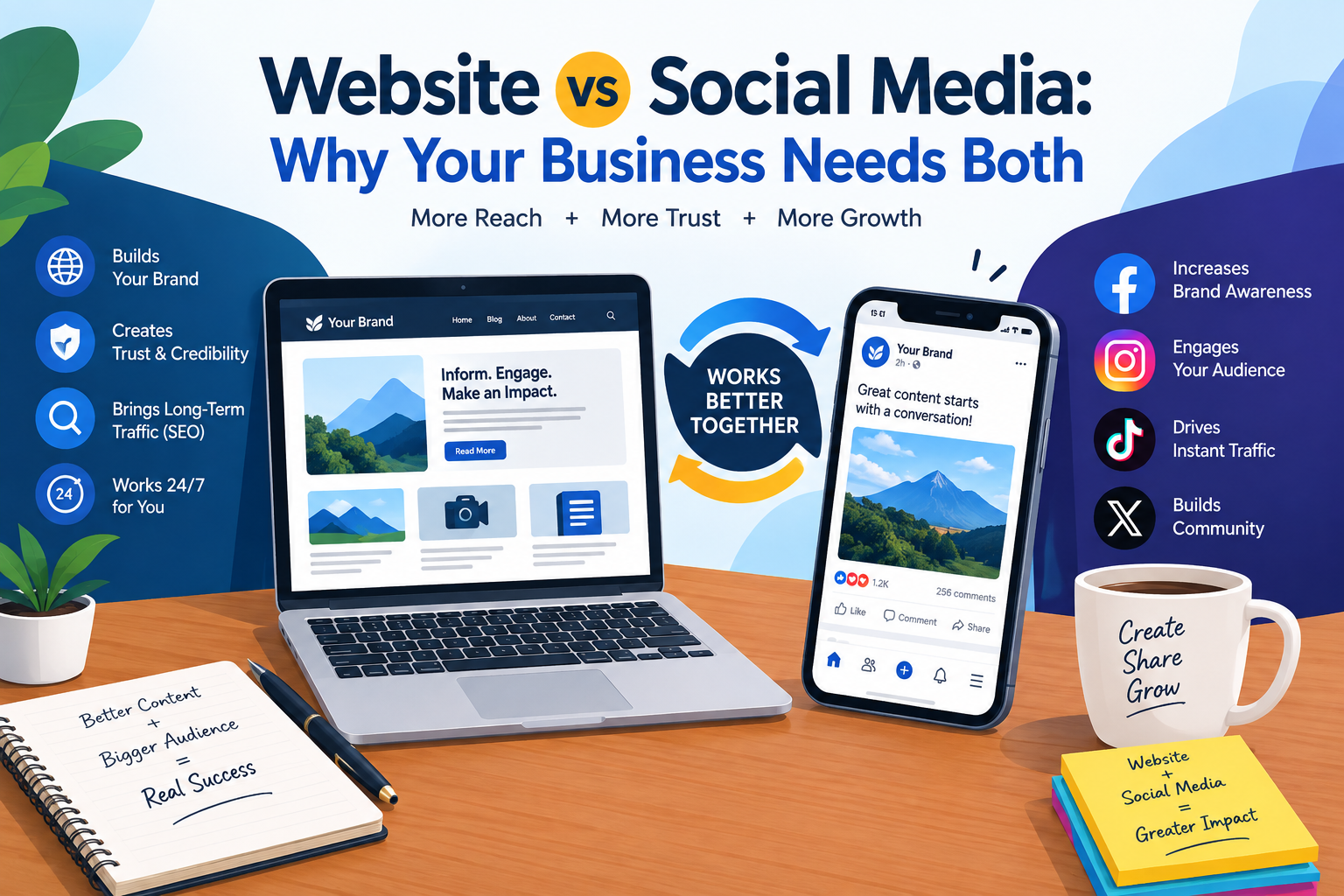
A website and social media have different strengths.
| Website | Social Media |
|---|---|
| Provides a central digital home | Provides audience access and interaction |
| Supports long-form content | Supports short-form and visual content |
| Can attract search traffic | Can generate social discovery |
| Greater control over content | Platform-dependent |
| Supports SEO | Supports engagement |
| Can host products and services | Helps promote products and services |
| Suitable for permanent resources | Excellent for ongoing conversations |
| Supports detailed information | Excellent for quick updates |
Rather than treating them as competitors, businesses should build a strategy where each supports the other.
How Websites and Social Media Can Work Together
Imagine that you run an online news publication.
You publish a detailed news article on your website.
The process could look like this:
Step 1: Publish the original article on your website.
Step 2: Optimise the article for search engines.
Step 3: Add an attractive featured image.
Step 4: Share the article on Facebook.
Step 5: Publish a short summary on X.
Step 6: Create an Instagram graphic or carousel.
Step 7: Produce a short video summarising the story.
Step 8: Share the link through appropriate messaging or community channels.
Step 9: Monitor website traffic and audience engagement.
This creates a connected digital ecosystem rather than treating every platform as an isolated channel.
Why This Is Particularly Important for News and Blog Publishers
For news websites and blogs, the relationship between websites and social media is especially important.
Your website should generally remain the primary publishing destination for your original articles.
Social media can then serve as a distribution and engagement channel.
This approach gives publishers opportunities to attract visitors from different sources, including:
- Google Search
- Social media
- Direct visitors
- Referral websites
- News discovery platforms
- Email newsletters
- Other digital channels
However, publishers should avoid relying entirely on one traffic source.
Search algorithms change. Social media algorithms change. Platform policies change.
A diversified traffic strategy can therefore make an online publication less dependent on a single platform.
Don’t Build Your Entire Business on Social Media
One of the biggest risks of relying exclusively on social media is that you do not control the platform.
A platform can change:
- Its algorithm
- Its advertising system
- Its content policies
- Its reach
- Its features
- Its account requirements
An account can also experience restrictions, hacking, suspension or other problems.
This does not mean businesses should abandon social media.
Instead, it means social media should complement your website rather than completely replace it.

Your website gives you a more stable foundation for your digital presence.
Don’t Build a Website and Ignore Social Media
The opposite mistake is also common.
Some businesses create a website and then rarely update it or promote its content.
A website that nobody discovers or visits may provide limited business value.
This is where social media can help.
Every useful article, service page, case study or announcement on your website can potentially become content for your social channels.
The website provides the depth.
Social media provides distribution and interaction.
A Simple Strategy for Businesses and Publishers
A practical digital strategy can follow this model:
Website = Foundation
Use your website for:
- Your main business information
- Original articles
- News publishing
- Services
- Products
- SEO
- Lead generation
- Contact forms
- Resources
Social Media = Distribution
Use social media for:
- Audience engagement
- Content promotion
- Brand awareness
- Community building
- Short-form content
- Videos
- Conversations
- Traffic generation
Analytics = Measurement
Use analytics tools to understand:
- Where visitors come from
- Which pages receive traffic
- Which content performs well
- How users interact with your website
- Which social channels send visitors
- What content your audience finds useful
This information can then guide your future content strategy.
Final Thoughts
The website vs social media debate should not be viewed as a choice between two competing digital channels.
For most businesses, content creators and news publishers, the two can serve different but complementary purposes.
Your website provides a digital home where you control and organise your important content, services and information.
Your social media channels provide opportunities to reach, engage and communicate with audiences where they already spend time online.
The strongest approach is therefore to build a website as the foundation of your digital presence and use social media to distribute content, build relationships and bring people back to your website.
For content creators and news publishers, this combination can be particularly valuable: create quality content on your website, optimise it for search, distribute it through social media, measure the results and continuously improve.
In simple terms:
Don’t choose between your website and social media. Build your website, grow your social media presence and make both work together.
Need Help With Your Website or SEO?
A professional website is more than an online brochure. It can become the foundation of your brand, content strategy, search visibility and digital growth.
Read also: How to Improve Website Speed and SEO in 2025 for Better Google Rankings
At ENGRMKS & CO., we help businesses, content creators and publishers with website design, WordPress development, website redesign, website maintenance and Search Engine Optimisation (SEO).
If your website needs improvement or you want to build a stronger online presence, get in touch with ENGRMKS & CO. and let’s build a digital platform that works for your goals.