How to Rank a News Website on Google in Kano
Kano is an important centre for news, business, education, politics, culture, and public affairs in Northern Nigeria. For digital publishers, this creates an opportunity to reach readers searching for breaking news, government announcements, community developments, sports, and business updates.
However, publishing news regularly does not automatically guarantee strong visibility on Google. Your website needs original reporting, effective search engine optimization (SEO), a technically sound structure, and a clear understanding of what your audience wants to read.
If you operate a news website in Kano, this guide explains how to improve your visibility on Google Search, strengthen your local relevance, and build a trusted news brand.
1. Understand What Your Kano Audience Searches For
The first step in ranking a news website is understanding the searches that matter to your readers.
People searching for news about Kano may use general phrases such as “Kano news today” or more specific searches related to local government areas, public institutions, political developments, education, business, or community events.
Start by identifying the main subjects your publication covers. These could include:
- Kano State politics and government.
- Local government and community news.
- Education and school announcements.
- Business, markets, and economic developments.
- Crime and public safety reporting.
- Sports and entertainment.
- Health, infrastructure, and public services.
- Northern Nigerian and national affairs.
Use Google Autocomplete, related searches, Google Trends, and Google Search Console to discover relevant topics and phrases.
For example, a publisher covering education might investigate search interest around Kano school announcements, admission updates, examination news, or education policies. Only publish claims supported by reliable information, and ensure that each article answers the reader’s actual question.
SEO tip: Do not create dozens of nearly identical pages targeting minor variations of the same keyword. Publish one useful, authoritative article when that best serves the reader.
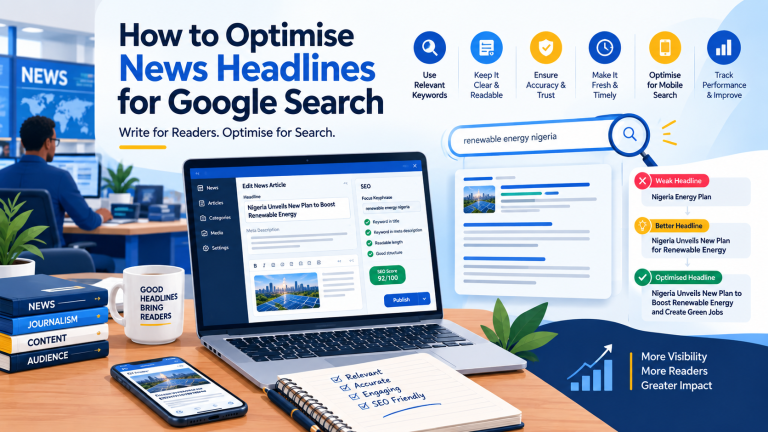
2. Optimize Your Headlines for Google Search
Your headline helps readers and search engines understand what an article covers. A clear, accurate headline can also encourage people to click your story when it appears in search results.
Compare these examples:
Weak headline:
“Important Development in Kano”
More descriptive headline:
“Kano State Announces New Public Transport Measures”
The second headline tells readers what happened and where. Use it only when it accurately reflects a verified announcement.
When writing news headlines:
- Put the main subject near the beginning when natural.
- Include “Kano” when the location is relevant to the story.
- State the main development clearly.
- Avoid unnecessary repetition of keywords.
- Do not exaggerate, mislead readers, or promise information the article does not contain.
- Keep the page title and visible article headline consistent.
For instance, if an article covers a verified change to a public service, name the institution or service in the headline rather than relying on vague wording.
Google may generate title links using multiple signals, so your HTML title, visible headline, and internal links should consistently describe the article. See Google’s SEO Starter Guide.
3. Publish Original, Accurate, and Useful News
Content quality is one of the most important foundations of a successful news website.
Publishing the same press release or rewriting another publisher’s report without adding meaningful information makes it harder for your website to stand out. Readers need a reason to choose your publication.
Strengthen your reporting by including:
- Original interviews and eyewitness accounts where appropriate.
- Statements from relevant officials or organizations.
- Clear explanations of how a development affects residents.
- Verified dates, locations, figures, and names.
- Context from earlier reporting.
- Relevant photographs, documents, or video.
- Corrections when an important factual error is discovered.
For example, rather than merely reporting that a road project has been announced in Kano, explain the location, the responsible authority, the project timeline if confirmed, and what the announcement means for affected communities.
Clearly distinguish confirmed facts from allegations, opinions, and information that has not yet been independently verified.
Google’s guidance emphasizes helpful, reliable, people-first content rather than content produced mainly to manipulate search rankings. Read its guide to creating helpful content.
4. Build Strong Local SEO Around Kano
Local SEO helps search engines understand the geographical relevance of your publication and its content.
For a Kano news website, location relevance should be reflected naturally throughout the site rather than added mechanically to every headline.
Consider creating well-organized sections for subjects such as:
- Kano State News.
- Kano Municipal and community news.
- Kano Politics.
- Kano Business and Economy.
- Kano Education.
- Kano Sports.
- Northern Nigeria News.
Use categories only when they help readers navigate your coverage. Avoid creating empty category pages or many near-duplicate pages for individual locations.
When reporting on a particular community or local government area, include its correct name in the headline or article when it helps readers understand the story.
Your publication should also have a clear About page, Contact page, editorial information, and accurate publisher details. These elements help readers understand who is responsible for the reporting.
Important: A Kano-focused keyword is not a substitute for useful reporting. Location terms should reflect the actual subject of each article.
5. Structure Your Website for Easy Navigation
A well-organized news website helps visitors discover related stories and makes it easier for search engines to find important pages.
A practical structure might look like this:
- Homepage
- Kano News
- Politics
- Business
- Education
- Sports
- Entertainment
- Northern Nigeria
- National News
- International News
Use descriptive category names and make sure important sections are reachable through normal HTML links.

For WordPress publishers, review your menu, category structure, breadcrumb navigation, and related-story links. Avoid creating excessive categories with only one or two unrelated posts.
Internal linking is particularly valuable for news websites. When publishing a follow-up story, link to the original report and other genuinely relevant coverage. For example, a report about a policy announcement can link to a previous explainer about the same policy.
Use descriptive anchor text rather than repeatedly using generic phrases such as “click here.”
A clear structure helps readers follow developing stories and discover the wider context of an issue.
6. Make Your Website Fast and Mobile-Friendly
Many readers access news through mobile devices. If your website is difficult to read, slow to load, or covered with intrusive advertisements, visitors may struggle to use it.
Review your website on different screen sizes and pay attention to:
- Loading speed.
- Readable font sizes.
- Responsive images.
- Simple menus.
- Stable page layouts.
- Clear article text.
- Advertisement placement.
- Unnecessary pop-ups and scripts.
Use Google PageSpeed Insights to identify performance problems. Compress large images, use suitable caching, remove unnecessary plugins, and consider reliable hosting that can handle traffic spikes during major news events.
A fast website supports a better user experience, but speed alone does not guarantee high rankings. Focus on the overall quality, usefulness, and accessibility of the website.
7. Set Up Google Search Console Correctly
Google Search Console is an essential free tool for monitoring how your news website performs in Google Search.
After verifying ownership of your website, use Search Console to monitor indexing, search queries, clicks, impressions, and technical problems.
Follow these steps:
- Add and verify your website property.
- Submit your XML sitemap.
- Inspect important article URLs.
- Review the Page Indexing report for problems.
- Monitor the Performance report to see which searches bring visitors.
- Check the Security Issues report if Google reports a possible security problem.
If a new article is not appearing in search results, use URL Inspection to check its indexing status. Requesting indexing does not guarantee that Google will index or rank the page.
Search Console can also reveal opportunities. An article may receive impressions for relevant searches but attract few clicks. In that case, assess whether the headline accurately reflects the content and whether the article fully answers the searcher’s question.
For official guidance, visit Google Search Console Help.
8. Optimize Your News Articles for Crawling and Indexing
News websites publish frequently, so search engines need to discover new stories and understand which pages are important.
Make sure every important article is accessible through at least one crawlable internal link. Avoid publishing stories that can only be reached through a search form or an inaccessible script.
Check that:
- Important articles return a successful HTTP response.
- Pages intended for search indexing are not accidentally blocked.
- Canonical URLs point to the appropriate version of each page.
- XML sitemaps contain valid URLs.
- Redirects lead to the correct destination.
- Duplicate URLs are managed properly.
If your publication uses WordPress, choose an SEO plugin and configure its sitemap features carefully. Verify the actual sitemap URL generated by your setup before submitting it to Search Console.
Should a news website use a Google News sitemap?
A news sitemap can help Google discover recent articles and can be useful for publishers that regularly produce news.
Google’s news sitemap guidance says that news-specific sitemap entries should cover articles published within the previous two days. Older articles should be removed from the news sitemap or have their news-specific metadata removed, while they may remain in the regular XML sitemap.
Read Google’s official news sitemap documentation.
A news sitemap supports discovery; it does not guarantee indexing, Google News inclusion, or higher rankings.
9. Use NewsArticle Structured Data
Structured data helps Google understand information about an article, including its headline, author, publication date, modification date, and associated image.
For a news website, relevant Schema.org markup may use the NewsArticle type.
Your implementation should accurately reflect the visible article. Include the correct headline, author information, publication timestamp, modification timestamp when applicable, and a relevant image.
If your website uses WordPress, check whether your SEO plugin or theme already generates Article structured data before installing another plugin. Duplicate or conflicting markup can make troubleshooting more difficult.
You can test your implementation using Google’s Rich Results Test and review relevant reports in Search Console.
Structured data is not a shortcut to the top of Google. Google states that Article markup can help it understand article pages, but there is no requirement to use it to be eligible for features such as Top stories.
Read the official Article structured data documentation.
10. Understand Google News and Top Stories
Google Search, the Google News app and website, and the Top stories feature are related but distinct ways readers may discover news.
Google automatically considers eligible publishers for Google News and news-related Search features. Publishers do not need to submit an application simply to become eligible. However, eligibility does not guarantee that a particular story will appear or rank prominently.
To improve your publication’s readiness:
- Produce original, relevant reporting.
- Maintain clear headlines and article pages.
- Display publication dates and author bylines.
- Provide accessible About, Contact, and publisher information.
- Follow Google’s news content and spam policies.
- Ensure article images and page content are crawlable.
- Monitor the Google News performance report in Search Console when available.
Google News ranking can take into account relevance, prominence, authoritativeness, freshness, usability, location, and language.
Do not assume that registering with Publisher Center will automatically improve rankings. Its tools can help publishers manage certain aspects of their presence, but they do not guarantee visibility.
See Google’s News content guidance and Google News ranking guidance.
11. Optimize Images and Multimedia
Relevant photographs can make news stories more useful and help readers understand an event.
Use original images when possible and ensure you have permission to publish them. Add descriptive filenames, useful alternative text, and captions that accurately identify the image where appropriate.
For example, an image of a verified public event could have a descriptive filename such as kano-public-event.jpg rather than IMG001.jpg.

Do not insert unrelated stock images simply to add visual content. Do not misrepresent an old photograph as a current event.
Use suitable image dimensions and compression to reduce loading time. Ensure important article images are accessible to search crawlers and that your page’s image metadata points to the appropriate image.
12. Build Authority Through Responsible Journalism and Relevant Links
Links from relevant, reputable websites can help readers discover your publication and provide context about your work. However, buying links or participating in manipulative link schemes can violate Google’s spam policies.
Build genuine recognition by:
- Producing original reporting that other publications may reference.
- Publishing useful explainers and data-based reports.
- Collaborating transparently with credible community organizations.
- Sharing stories through appropriate social channels.
- Correcting errors and maintaining editorial standards.
- Providing clear author biographies and publication information.
Do not exchange links solely to manipulate rankings or pay for links intended to pass ranking credit. Prioritize real audience value and editorial credibility.
13. Track Results and Improve Your SEO Strategy
SEO for a news website is an ongoing process. Review performance regularly instead of judging success by one article or a short period of traffic.
Use Search Console to monitor:
- Which queries bring impressions and clicks.
- Which articles attract the most organic traffic.
- Which pages have high impressions but low click-through rates.
- Whether important articles are indexed.
- Which countries and devices generate traffic.
- Whether your Google News reports show activity.
Compare similar time periods and account for the news cycle. A major political event can generate temporary traffic that does not reflect your website’s normal performance.
Use the findings to improve headlines, update evergreen explainers with verified information, strengthen internal links, and address technical problems.
Avoid changing publication dates merely to make old stories appear new. Update an article’s date when substantial changes genuinely justify it, and make sure the displayed date and structured data are accurate.
A Practical 30-Day SEO Plan for a Kano News Website
Week 1: Technical foundation
- Verify Google Search Console.
- Submit and check the XML sitemap.
- Review indexing errors and mobile usability.
- Test website speed and navigation.
Week 2: Content and local relevance
- Review your category structure.
- Improve vague or misleading headlines.
- Strengthen About, Contact, and author pages.
- Publish original reporting relevant to your audience.
Week 3: News SEO
- Review Article structured data.
- Check publication dates, bylines, and article images.
- Confirm that recent stories are internally linked.
- Evaluate whether a news sitemap is appropriate.
Week 4: Measurement and improvement
- Review queries, impressions, clicks, and CTR.
- Identify important pages with indexing problems.
- Improve articles that do not fully answer reader questions.
- Plan follow-up coverage around subjects your readers value.
Repeat the process monthly and adjust your priorities based on evidence.
Frequently Asked Questions
How long does it take for a Kano news website to rank on Google?
There is no fixed timeline. Some stories may appear in search results relatively quickly, while building sustained visibility for competitive searches may take much longer. Indexing and ranking depend on factors such as relevance, content quality, competition, technical accessibility, and the search query.
Does my news website need to be registered with Google News?
No application is required for automatic consideration for Google News or news-related Search features. Publishers must still comply with applicable policies, and inclusion or prominent ranking is not guaranteed.
Is WordPress suitable for a news website in Kano?
Yes. WordPress can support a news website when it is configured with a suitable theme, clear categories, reliable hosting, appropriate security, and properly managed SEO settings. Performance and content quality depend on how the site is built and maintained.
Should every article contain the keyword “Kano news”?
No. Use the location term when it accurately describes the story. Repeating the same phrase in every article can make headlines and content unnatural. Specific, accurate descriptions are generally more useful to readers.
Can social media help a Kano news website grow?
Yes. Social platforms can help readers discover and share your reporting, build an audience, and bring visitors to your website. Social sharing does not guarantee higher Google rankings, so combine it with strong editorial content and sound technical SEO.
Conclusion
Ranking a news website on Google in Kano requires more than publishing frequent updates or repeating local keywords. The strongest long-term strategy combines original and accurate journalism, relevant local coverage, clear headlines, a well-organized website, fast mobile performance, effective internal linking, and consistent monitoring through Google Search Console.
Start by fixing technical problems and improving your most important articles. Then build a clear editorial identity around the topics your readers care about.
With consistent reporting, transparent publishing practices, and ongoing optimization, your website can improve its chances of reaching readers in Kano, Northern Nigeria, and beyond. No SEO technique can guarantee a particular ranking, but a useful, trustworthy publication gives readers and search engines stronger reasons to discover your work.