


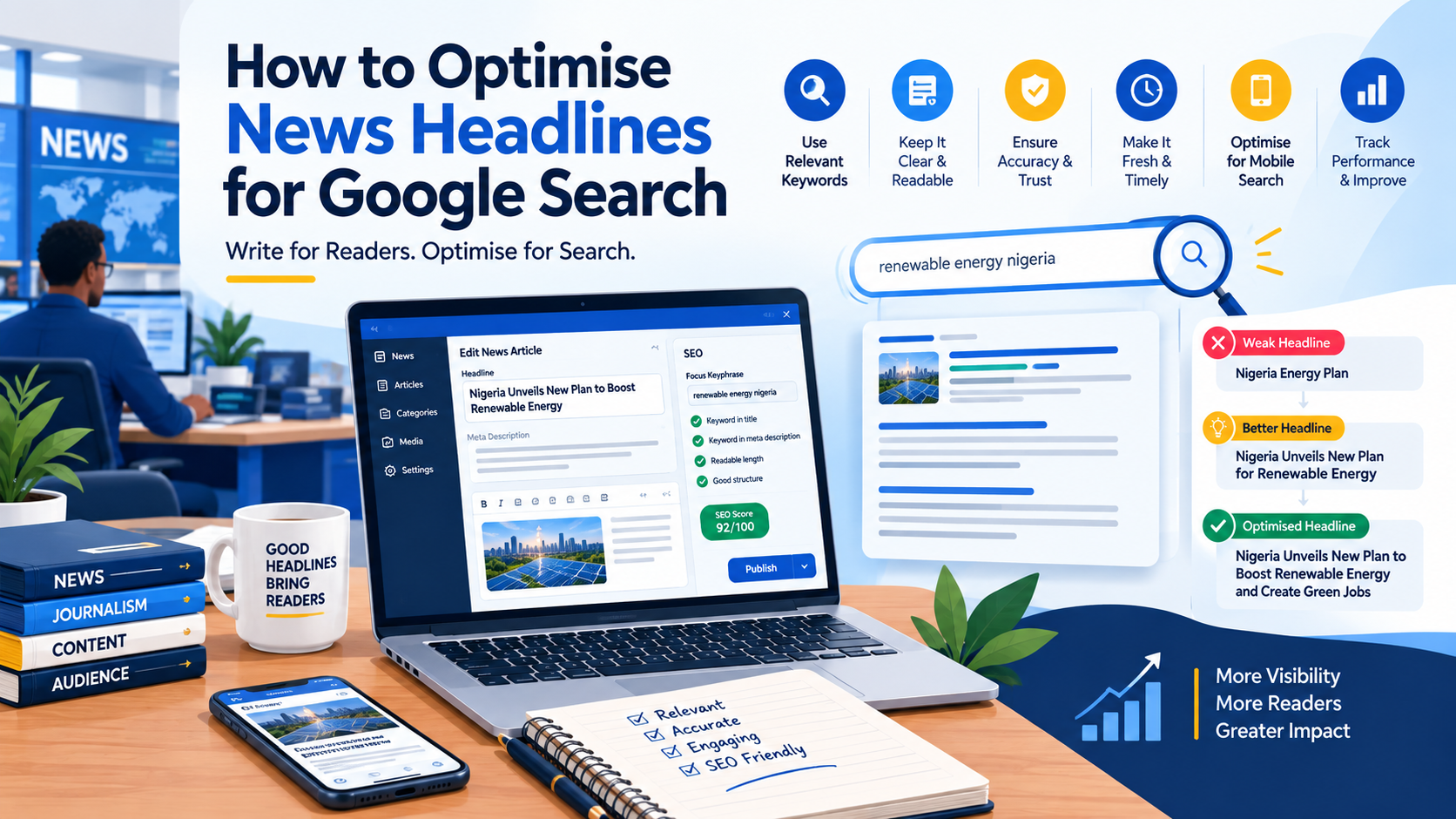
How to Optimise News Headlines for Google Search
For news publishers, bloggers and content creators, the headline is one of the most important parts of an article.
A strong headline can immediately tell readers what a story is about, encourage them to click, and help search engines understand the subject of the page. A weak headline, on the other hand, can make an otherwise excellent article difficult to discover or understand.
Read also: How to Migrate Your Website to a New Hosting Provider in Nigeria: Step-by-Step Guide
But writing headlines for the web is different from writing headlines only for a printed newspaper.
Today, a news headline may appear on your website, Google Search, Google News, social media, news aggregators, messaging platforms and other digital channels. Google can also generate or adjust the title link displayed in Search based on several signals from the page, including the <title> element, the visible main title, headings, og:title, page content and links pointing to the page.
This means online publishers need to think carefully about both readability and search visibility.
In this guide, we will explain how to optimise news headlines for Google Search without making them robotic, misleading or stuffed with keywords.
Why News Headlines Matter for SEO
A headline performs several jobs at the same time.
It tells the reader:
- What the story is about
- Who or what is involved
- Why the story may be important
- What information they can expect to find
It also provides search engines with important context about the page.
Google’s Search Essentials recommends creating helpful, reliable, people-first content and using words that people would use to search for the content in prominent locations such as the page title and main heading.
However, this does not mean that publishers should simply insert as many keywords as possible into every headline.
The goal is to create a headline that is:
Clear + Accurate + Relevant + Useful + Search-Friendly
1. Clearly Tell Readers What Happened
The first rule of an effective news headline is clarity.
Readers should not have to guess what the article is about.
Compare these examples:
Weak:
Big Development Rocks Kano
Better:
Kano Government Announces New Development Plan for Local Communities
The second headline provides much more information.
A reader can immediately understand:
- The location
- The organisation involved
- The type of development
- The subject of the story
Search engines can also use the words and context on the page to better understand what the article covers.
For news publishers, clarity should come before cleverness.
2. Put the Most Important Information Near the Beginning
Online readers often scan headlines quickly, especially on mobile devices.
Therefore, important information should not be buried at the end.
For example:
Less effective:
Following Several Months of Discussions, State Government Finally Announces New School Feeding Programme
More direct:
State Government Announces New School Feeding Programme After Months of Talks
The second version communicates the main development much faster.
This approach is particularly useful for breaking news, where readers want to understand the event immediately.
3. Use the Words People Actually Search For
One of the most useful SEO principles for news publishers is to understand how people describe the subject of a story.
Suppose you are writing about a new policy affecting motorists in Kano.
A vague headline might say:
New Policy Announced for Motorists
A more descriptive headline might say:
Kano Introduces New Traffic Rules for Commercial Motorists
The second headline provides important contextual terms.
Instead of trying to guess dozens of keywords, identify the main subject of the story and use natural language to describe it.
Google recommends using words that people would use when looking for your content, particularly in prominent locations such as titles and headings.
4. Include the Location When Location Matters
For Nigerian news publishers, location can be extremely important.
A story about an event in Kano may compete with stories about similar events in Abuja, Lagos, Kaduna, Katsina or other locations.
Compare:
Government Announces New Agricultural Programme
with:
Kano Government Announces New Agricultural Programme
The second headline gives the reader immediate geographic context.
Where appropriate, consider including:
- City
- State
- Local Government Area
- Country
- Institution
- Organisation
For example:
Kano Police Arrest Suspect Over Alleged Phone Theft
This is much more informative than:
Police Arrest Suspect Over Phone Theft
However, do not add locations simply to target keywords. The location should genuinely be relevant to the story.
5. Mention the Main Person, Organisation or Institution
News readers frequently search for specific names.
If a story concerns a governor, minister, organisation, university, company, football club or other recognisable entity, the headline should normally identify that entity when it is central to the story.
Instead of:
Governor Makes New Announcement
consider:
Kano Governor Announces New Measures to Improve Public Transport
The second headline provides considerably more context.
The same principle applies to organisations.
Instead of:
University Releases Important Statement
consider:
Bayero University Kano Releases Statement on Admission Process
The key is to identify the actual subject of the story.
6. Avoid Clickbait Headlines
Clickbait may generate curiosity, but misleading headlines can damage reader trust.
Examples include:
You Won’t Believe What Happened Next!
This One Decision Has Changed Everything!
What They Don’t Want You to Know About Kano!
These headlines provide little useful information.
A stronger approach is to tell readers enough about the story to understand why it matters.
For example:
Clickbait:
You Won’t Believe What the Government Just Announced!
Informative:
Government Announces New Tax Measures for Small Businesses
The second headline gives the reader meaningful information before the click.
For publishers building a long-term news brand, accuracy and credibility should remain more important than short-term curiosity.
7. Avoid Keyword Stuffing
One of the biggest mistakes publishers make when learning SEO is repeating the same keyword several times.
For example:
Kano News: Kano Government News, Kano Latest News, Kano News Today and Latest Kano News
This is unnatural and provides a poor user experience.
Google specifically identifies keyword stuffing as a spam practice when keywords are repeated unnaturally in an attempt to manipulate rankings.
A much better headline would be:
Kano Government Announces New Measures to Improve Public Services
One clear, descriptive headline is better than a collection of repeated search terms.
8. Make Headlines Specific
Specificity is one of the easiest ways to improve a headline.
Compare:
Government Approves New Programme
with:
Kano Government Approves ₦2 Billion Programme for Youth Skills Development
The second headline tells readers significantly more.
When the facts are confirmed and appropriate for publication, consider including useful details such as:

- Numbers
- Locations
- Names
- Organisations
- Dates
- Amounts
- Policy names
- Specific actions
However, never add details simply to make a headline appear more interesting.
Every important claim in a headline should accurately reflect the article.
9. Use Numbers Carefully
Numbers can make headlines more specific and easier to scan.
Examples include:
10 Things to Know About the New Education Policy
5 Key Changes in Nigeria’s New Tax Rules
3 Major Roads to Be Rehabilitated in Kano
Numbers can work particularly well for explanatory articles, guides and list-based content.
For breaking news, however, the headline should focus on the actual development rather than forcing a numbered format where it does not belong.
10. Use Strong but Accurate Verbs
Compare:
Government Makes Announcement on New Housing Scheme
with:
Government Launches New Housing Scheme
The second is more direct.
Other useful verbs can include:
- Announces
- Launches
- Approves
- Suspends
- Signs
- Opens
- Arrests
- Appoints
- Releases
- Confirms
- Orders
- Begins
- Completes
- Warns
- Introduces
But accuracy is critical.
Do not use “confirms” if the information has not actually been confirmed.
Do not use “arrests” if authorities only said they were investigating someone.
Do not use “approves” if a proposal has merely been submitted.
The headline must reflect the facts of the story.
11. Don’t Write Headlines Only for Google
This is extremely important.
Your headline should be written primarily for people, not algorithms.
Google’s current Search Essentials emphasise helpful, reliable, people-first content.
A headline such as:
Kano Latest News Today Kano Government Latest News Kano News Update
may contain words someone could search for, but it does not read naturally.
A better headline is:
Kano Government Announces New Measures to Improve Public Transport
The second headline communicates the story naturally while still containing useful contextual terms.
12. Understand the Difference Between the Headline and Google’s Title Link
This is an important technical SEO issue for news publishers.
The headline visible on your article page and the title link shown in Google Search can be related, but they are not necessarily identical.
Google says it can generate title links from multiple sources, including:
Read also: Why Is My WordPress Website Slow? 15 Causes & Solutions
- The
<title>element - The main visual title
- Heading elements such as
<h1> og:title- Prominent page text
- Anchor text
- Links pointing to the page
WebSitestructured data
Google may adjust the title link when it believes another version better represents the page.
Therefore, publishers should maintain consistency.
For example:
Visible headline:
Kano Government Launches New Youth Skills Programme
SEO title:
Kano Government Launches New Youth Skills Programme | News Website
The two should clearly refer to the same story.
Avoid having a visible headline that says one thing while the HTML title says something completely different.
13. Keep the <title> Descriptive and Concise
Google recommends that every page have a title specified in the <title> element and that title text be descriptive and concise. It also warns against unnecessarily long titles and keyword stuffing.
For a news article, a practical structure can be:
Main News Headline | Publication Name
For example:
Kano Government Approves New Youth Development Programme | Example News
However, do not blindly append a long publication name to every title if it makes the title unnecessarily verbose.
The important thing is that the title clearly identifies the article.
14. Optimise Headlines for Mobile Readers
A large percentage of online news consumption happens on mobile devices.
That means your headline needs to remain understandable when displayed in a small space.
Before publishing, ask:
Can someone understand the main story from the first part of the headline?
Avoid unnecessarily long introductions.
For example:
Following a Meeting Held on Tuesday Between Government Officials and Representatives of Several Communities…
This delays the important information.
Instead:
Government Meets Communities Over Flood Prevention Measures
The second version is easier to scan.
15. Don’t Hide the Main Story Behind Clever Wordplay
Traditional newspapers sometimes use clever headlines that depend on readers understanding the context.
Digital publishing requires additional consideration because people may discover an article through search without knowing anything about the story.
For example:
A New Dawn for the City
This could refer to almost anything.
A descriptive headline is more useful:
Kano Begins Major Urban Renewal Project
Readers immediately know what the story concerns.
This does not mean creative headlines are forbidden. It means that clarity should not be sacrificed for creativity.
16. Use Current Information in Time-Sensitive Stories
News changes quickly.
A headline that was accurate yesterday may become incomplete or misleading today.
For example:
Government Approves New Fuel Policy
could become outdated if the policy is subsequently suspended or modified.
Publishers should review important articles when significant developments occur.
Google can use publication and modification information when determining byline dates. Google recommends making dates visible on the page and using structured data such as datePublished and dateModified to help its systems understand the dates.
This is particularly useful for developing stories and evergreen news explainers.
17. Use Article Structured Data Correctly
Headline optimisation is not only about writing.
Technical implementation matters too.
Google supports Article structured data for news, blog and other article pages. Using Article, NewsArticle or BlogPosting structured data can help Google understand information such as the article headline, author, images and publication dates.
A properly implemented NewsArticle schema can include information such as:
- Headline
- Image
- Date published
- Date modified
- Author
- Author URL
Structured data does not guarantee higher rankings or a particular search appearance. Its role is to help Google understand the content and potentially make it eligible for relevant search features.
18. Make the Headline Match the Article
This may sound obvious, but it is a common problem.
If your headline promises:
Kano Government Approves ₦5 Billion Road Project
the article should actually explain that approval.
Do not create a headline around information that appears only briefly in the article.
The headline should accurately summarise the central news development.
A useful test is:
If a reader reads only the headline, will they have an accurate understanding of what the article is about?
If the answer is no, rewrite it.
19. Use Search Console to Improve Your Headlines
One of the best ways to improve your headline strategy is to study actual search performance.
Google Search Console can help publishers examine:
- Search queries
- Impressions
- Clicks
- Click-through rate
- Search performance
- Pages receiving search traffic
Suppose an article receives thousands of impressions but relatively few clicks.
That may be a reason to review the search appearance, including the title and description, while also considering the query intent and competition.
Do not assume that changing a headline will automatically increase rankings.
Instead, use Search Console as a source of evidence and continuously test and improve your content strategy.
20. Create Headlines That Answer Search Intent
Search intent refers to what someone is trying to find when they perform a search.
For news websites, different searches may have different intentions.
For example:
Search:
Kano governor latest announcement
A headline such as:

Kano Governor Announces New Measures to Improve Public Transport
may clearly address that intent if the article covers the announcement.
For explanatory content:
Search:
how new tax law affects businesses
A headline such as:
New Tax Rules: How They Could Affect Nigerian Businesses
may better match the informational intent.
The closer your headline and article are to the actual subject of the search, the clearer the content becomes to readers and search systems.
Common News Headline SEO Mistakes to Avoid
Here are some common mistakes online publishers should watch for:
1. Keyword stuffing
Repeating the same keyword unnecessarily can make the headline look unnatural and may violate Google’s spam policies when done manipulatively.
2. Excessive punctuation
Avoid headlines filled with unnecessary:
!!! WOW!!! SHOCKING!!! MUST READ!!!
A professional news headline is usually clearer without excessive punctuation.
3. Misleading claims
Never exaggerate the story simply to attract clicks.
4. Vague headlines
Avoid headlines that fail to explain what actually happened.
5. Extremely long headlines
Long headlines may dilute the main message and become difficult to scan.
6. Duplicate headlines
Every article should have a distinct headline that accurately describes its content.
7. Outdated information
Update headlines when the underlying facts materially change.
8. Writing only for keywords
Search optimisation should support good journalism, not replace it.
A Simple Formula for SEO-Friendly News Headlines
A useful formula for many news stories is:
[Main Subject] + [Action] + [Important Development] + [Location/Context]
For example:
Kano Government Approves New Youth Skills Programme
Another structure is:
[Person/Organisation] + [Action] + [Specific Result]
Example:
Federal Government Approves New Measures to Support Small Businesses
For explanatory stories:
[Topic] + [What Readers Need to Know]
Example:
New Tax Rules: What Nigerian Small Businesses Need to Know
For list-based articles:
[Number] + [Useful Information] + [Topic]
Example:
7 Things to Know About Nigeria’s New Education Policy
These are frameworks, not rigid rules. The best structure depends on the story.
A Practical Headline Checklist for News Publishers
Before clicking Publish, ask these questions:
Headline SEO Checklist
- Is the headline accurate?
- Does it clearly describe the story?
- Is the main subject obvious?
- Does it contain important contextual information?
- Is the location relevant?
- Is the main keyword or search phrase naturally included?
- Is the headline easy to understand?
- Is it readable on mobile?
- Does it avoid keyword stuffing?
- Does it avoid misleading clickbait?
- Does it match the article content?
- Is the SEO
<title>consistent with the visible headline? - Is the headline unique?
- Are names and organisations spelled correctly?
- Are figures and claims accurate?
- If the story has changed, has the headline been updated?
If you can answer yes to most of these questions, your headline is likely in a much stronger position from a usability and SEO perspective.
Final Thoughts
Optimising news headlines for Google Search is not about writing headlines that are stuffed with keywords.
It is about communicating the story clearly, accurately and naturally while making it easy for both readers and search engines to understand the subject.
For online news publishers, the best headline strategy combines journalism and SEO.
Write for the reader first.
Identify the central news development.
Use relevant names, places and topics where appropriate.
Put important information near the beginning.
Avoid misleading clickbait.
Avoid keyword stuffing.
Keep your page title and visible headline consistent.
Use appropriate Article or NewsArticle structured data.
Keep publication and update dates accurate.
Then monitor performance through Search Console and use the data to improve your content strategy.
Remember that Google automatically generates title links and may use several signals from your page rather than displaying your exact headline every time.
There is therefore no single headline formula that guarantees a top Google ranking.
Instead, focus on producing helpful, reliable, original and well-optimised news content with headlines that accurately communicate what readers will find.
For news publishers, a good headline does more than attract a click.
It tells the story, establishes context, supports discoverability and gives readers a reason to trust your publication.
Want to Improve Your News Website’s Google Visibility?
Publishing news consistently is only one part of running a successful online publication. Your website structure, technical SEO, headlines, internal linking, article schema, indexing, page speed and content strategy can all affect how effectively your stories are discovered online.
Read also: Website vs Social Media: Why Your Business Needs Both
At ENGRMKS & CO., we help businesses, bloggers and online publishers with WordPress website development, website redesign, website maintenance, SEO and digital publishing solutions.
If you run a news website or blog and want to improve how your articles are prepared for Google Search, contact ENGRMKS & CO. for professional SEO and website support.