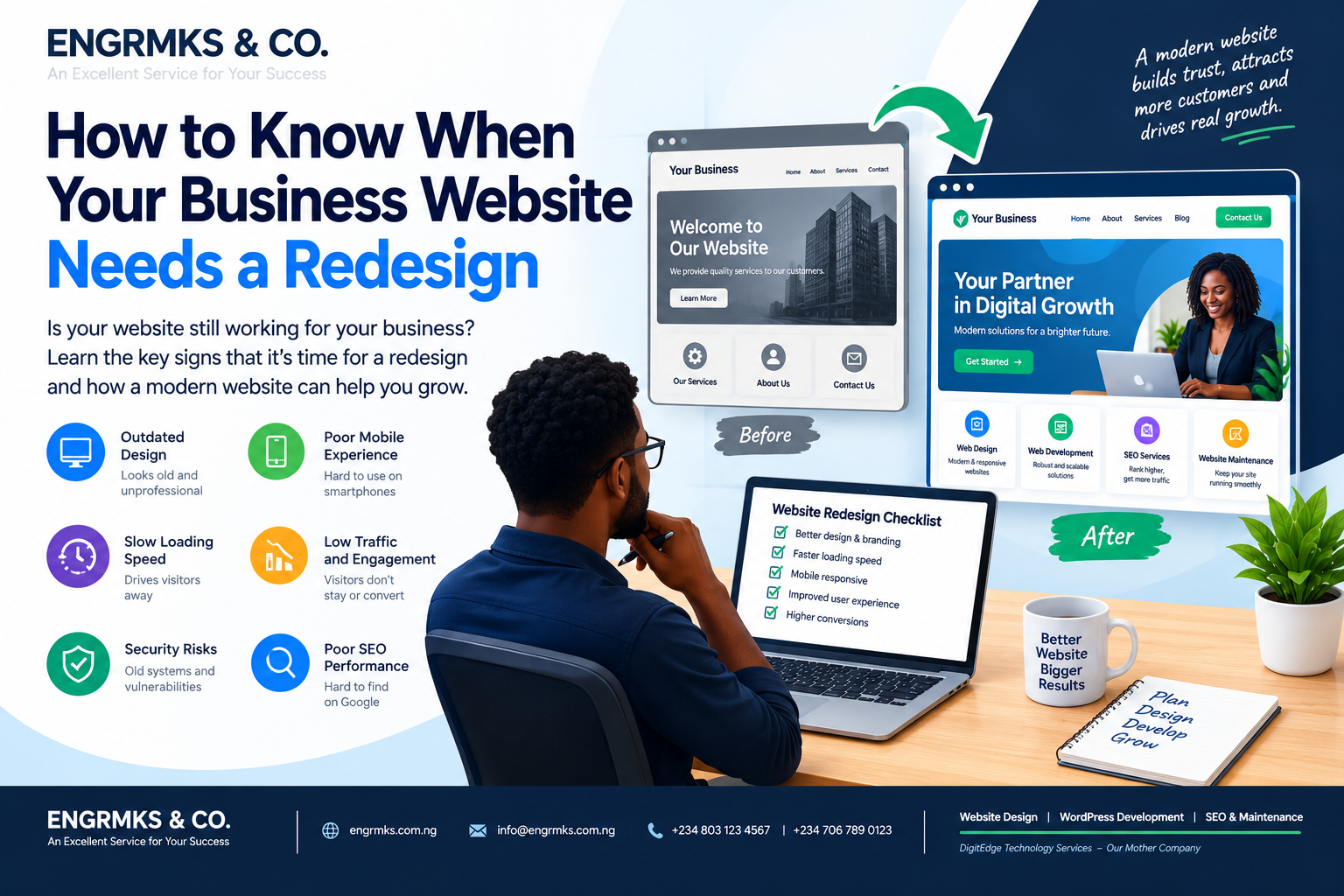
How to Know When Your Business Website Needs a Redesign
Your website may have been professionally designed when your business started, but that does not mean it will remain effective forever.
Technology changes. Customer expectations change. Search engines evolve. Mobile usage grows. Your competitors improve their websites. Even your own business may have changed significantly since the website was launched.
This raises an important question for business owners, bloggers, content creators and publishers:
How do you know when your business website needs a redesign?
A website redesign is not simply about making a website look more attractive. A properly planned redesign can improve usability, mobile experience, website speed, SEO, security, content presentation and the way visitors interact with your business.
For Nigerian businesses competing for customers online, these factors can be particularly important because your website may be the first place a potential customer goes after finding your business through Google, social media, WhatsApp or a referral.
If your website looks outdated, loads slowly, is difficult to navigate or no longer represents your business properly, it may be time for a redesign.
What Is a Website Redesign?
A website redesign involves improving an existing website’s appearance, structure, functionality, content, technology or user experience.
A redesign can range from a visual refresh to a complete rebuilding of the website.
For example, a business may redesign its website to:
- Improve mobile responsiveness
- Modernise the visual design
- Improve website speed
- Simplify navigation
- Improve SEO
- Add new services
- Improve security
- Integrate WhatsApp or other communication channels
- Improve contact forms
- Add online payments
- Improve content management
- Strengthen local SEO
- Make the website easier to maintain
The objective should not simply be to create a “beautiful website.”
The objective should be to create a website that works better for your business and your audience.
1. Your Website Looks Outdated
One of the easiest signs to notice is an outdated design.
If your website looks like it was built many years ago, visitors may question whether the business is still active—even if the company is doing well.
Common signs of an outdated website include:
- Old-fashioned layouts
- Excessive text
- Poor typography
- Low-quality images
- Inconsistent colours
- Cluttered menus
- Tiny fonts
- Outdated graphics
- Broken visual elements
- Poor spacing
- Old company information
Your website should reflect your current brand.
A modern website does not necessarily have to be complicated. In many cases, a clean layout, strong typography, good images and clear navigation can make a significant difference.
2. Your Website Does Not Work Properly on Mobile Phones
This is one of the most important reasons to consider a redesign.
Many customers now access websites using smartphones.
If visitors have to zoom in, scroll sideways or struggle to click buttons on a phone, the website needs attention.
Google’s current page-experience guidance recommends that websites display well on mobile devices and provide a good overall experience. Google also uses Core Web Vitals in its ranking systems, although good scores alone do not guarantee top search rankings.
Test your website on:
- Android phones
- iPhones
- Tablets
- Laptops
- Desktop computers
Do not test only on the device you personally use.
A website should work properly across the devices your audience uses.
3. Your Website Is Too Slow
Website speed is another major warning sign.
If your homepage takes too long to load, visitors may leave before seeing your products, services or content.
Slow websites can be caused by:
- Poor hosting
- Unoptimized images
- Excessive plugins
- Bloated themes
- Unnecessary scripts
- Poorly configured caching
- Too many advertisements
- Poor database performance
- Outdated technology
Google recommends considering Core Web Vitals and the overall page experience when improving websites. However, Google also makes clear that achieving good Core Web Vitals does not automatically guarantee high rankings.
Therefore, speed improvements should be viewed both as an SEO consideration and as a user-experience improvement.
4. Your Website Is Difficult to Navigate
Imagine a potential customer visits your website looking for your services but cannot figure out where to click.
That is a problem.
Your navigation should make it easy for visitors to find important information.
For a typical Nigerian business website, important sections might include:
- Home
- About Us
- Services
- Products
- Blog/News
- Portfolio
- Contact
- FAQs
The exact structure depends on the business.
A website redesign is an opportunity to reorganize your navigation around what visitors actually need.
5. Your Business Has Changed
Perhaps your website was created when your company offered three services.
Now you offer ten.
Maybe you have opened a new branch, changed your phone number, introduced new products or expanded into another city.
If your website still describes the old business, it is time to update it.
Your website should accurately communicate:
- What your business does
- Who you serve
- Where you operate
- What products or services you provide
- How customers can contact you
- Why customers should consider your business
A redesign can help bring the website and the current business strategy together.
6. Your Website Is Not Generating Leads
A website should have a purpose.
For a business, that purpose may be to generate:
- Phone calls
- WhatsApp enquiries
- Contact-form submissions
- Bookings
- Sales
- Store visits
- Newsletter subscriptions
- Downloads
- Consultation requests
If people are visiting your website but rarely take action, investigate why.
Your calls to action may be unclear.
For example, instead of making visitors search for your phone number, consider clearly displaying:
Call Us
Chat on WhatsApp
Request a Quote
Book a Consultation
Get Started
The right CTA depends on the business.
7. Your Website Is Difficult to Find on Google
A redesign may be necessary if your website has serious SEO and structural problems.
Warning signs include:
- Important pages are not indexed
- Poor search visibility
- Missing or weak page titles
- Poor URL structure
- Broken internal links
- Missing sitemap
- Incorrect canonical tags
- Poor mobile experience
- Weak internal linking
- Duplicate content problems
- Poor site architecture
However, a redesign should not be treated as a magic solution to SEO problems.
Google’s Search guidance emphasizes technical requirements, spam policies and creating useful content for people.
If the website has good content but poor technical foundations, a redesign may provide an opportunity to correct those problems.
8. Your Website Does Not Reflect Your Brand
Branding evolves.
Your company may have a new:

- Logo
- Colour scheme
- Slogan
- Service offering
- Photography style
- Brand voice
If your website still uses the old identity, visitors may receive an inconsistent impression.
A website redesign can bring your online presence in line with your current brand.
For professional businesses, this matters because your website often acts as a digital representation of the company.
9. Your Website Is Not Secure or Uses Outdated Technology
Security should never be ignored.
If your website uses outdated software, unsupported plugins or an old CMS configuration, it may be exposed to unnecessary risks.
Warning signs include:
- Old WordPress version
- Abandoned plugins
- Unsupported themes
- Insecure forms
- No HTTPS
- Repeated malware warnings
- Outdated PHP
- Unnecessary administrator accounts
A redesign or rebuild may be appropriate when the existing system is difficult to maintain securely.
However, do not redesign simply because a website is old. Sometimes updating the CMS, theme, plugins and hosting environment is enough.
10. Your Website Has Too Many Broken Links
Broken links create a poor experience.
A visitor may click:
Our Services → Website Design
and receive a 404 error.
This can make the website appear neglected.
Before undertaking a complete redesign, audit:
- Internal links
- Navigation menus
- Buttons
- Contact forms
- Images
- Downloads
- External links
- Redirects
If the website has accumulated many broken URLs over the years, a redesign can be an opportunity to clean up the site’s architecture.
11. Your Content Is Outdated
A website redesign is not only about colours and layouts.
Content matters.
Imagine a business website still displaying:
“Our company has been providing services for 10 years.”
But the company has now operated for 17 years.
Or the website lists services that the company no longer provides.
That information should be updated.
During a redesign, review:
- Homepage copy
- Service descriptions
- About Us page
- Contact information
- Team profiles
- Testimonials
- FAQs
- Blog posts
- Product descriptions
- Images
- Company statistics
Google’s search documentation emphasizes creating helpful, reliable, people-first content rather than content produced primarily to manipulate search rankings.
12. Your Local SEO Is Weak
For businesses serving specific Nigerian cities or regions, local visibility can be extremely important.
For example, a business operating in Kano may want potential customers to find it when searching for relevant services in Kano.
Similarly, businesses operating in Abuja, Kaduna, Lagos, Katsina, Jigawa or other locations may benefit from making their location and service areas clear.
Your website should clearly communicate:
- Business name
- Physical location where appropriate
- Service areas
- Phone number
- Email address
- Opening hours
- Services
- Contact options
Google supports LocalBusiness structured data, which can provide information such as business hours and other business details to help Google understand a local business page.
Local SEO should also be approached honestly. Do not create fake locations or misleading business information simply to target additional cities.
13. Your Website Does Not Integrate With Your Marketing Channels
Modern businesses rarely rely on their website alone.
You may already use:
- TikTok
- YouTube
- Email marketing
- Google Business Profile
- Online advertising
Your website should work together with these channels.
For example, a visitor coming from Facebook should easily be able to:
Learn → Trust → Contact → Buy
If the website creates unnecessary friction, you may lose potential customers.
14. Your Website Is Difficult to Update
This is particularly important for bloggers, content creators and news publishers.
If adding a new article requires technical assistance every time, your publishing workflow is inefficient.
A modern content-driven website should allow authorized staff to manage content efficiently.
For WordPress websites, this could include:
- Creating posts
- Uploading images
- Managing categories
- Adding authors
- Updating pages
- Managing menus
- Optimizing metadata
- Managing media
The technology should support the business rather than make everyday work harder.
15. Your Competitors’ Websites Are Providing a Better Experience
Your competitors’ websites can provide useful information during a website review.
Look at:
- How quickly their pages load
- How their services are presented
- How easy their navigation is
- How they display contact information
- How they use images
- How they communicate their value
- How they handle mobile users
This does not mean copying competitors.
Instead, identify opportunities to improve your own customer experience.
Website Redesign Does Not Mean Starting From Zero
A common misconception is that every redesign requires deleting the old website and building everything again.
Not necessarily.
A professional website audit should come first.
Some websites need:
Minor Refresh
New colours, typography, images and layout improvements.
Structural Redesign
Improved navigation, content organization, mobile responsiveness and calls to action.
Technical Rebuild
Migration to a better CMS, improved hosting, updated technology and improved security.
Complete Redesign
New design, content structure, technology, SEO architecture and functionality.
The right approach depends on the condition and objectives of your existing website.
How Often Should a Business Redesign Its Website?
There is no universal rule that says every website must be redesigned after a specific number of years.
Instead, monitor performance.
A website may need significant work when:
- It no longer supports business goals
- Customers struggle to use it
- It performs poorly on mobile
- It is difficult to maintain
- It has serious security issues
- Its content is outdated
- Its SEO architecture is weak
- It produces poor conversion results
- The brand has changed significantly
A five-year-old website can still be effective if it is well maintained.
A two-year-old website can already require redesigning if it was poorly built.
What Should You Check Before Redesigning?
Before hiring a developer, create a website audit.
Review:
Design
Is the website visually modern and consistent with your brand?
Mobile
Does it work properly on smartphones?

Speed
Are important pages loading efficiently?
SEO
Can search engines crawl and understand the important pages?
Content
Is the information accurate and useful?
Security
Are the CMS, plugins and server environment properly maintained?
Conversion
Can visitors easily contact you or take the desired action?
Analytics
Do you know which pages attract visitors and where users leave?
Local Visibility
Can people understand where your business operates?
These answers will help determine whether you need a complete redesign or targeted improvements.
A Website Redesign Checklist for Nigerian Businesses
Before launching a redesigned website, check the following:
Design
- Modern and professional appearance
- Consistent branding
- Clear typography
- High-quality images
- Simple navigation
Mobile
- Responsive layout
- Easy-to-use buttons
- Readable text
- No unnecessary horizontal scrolling
SEO
- Proper page titles
- Descriptive URLs
- Internal linking
- XML sitemap
- Correct canonical URLs
- Search-friendly content
- Proper redirects for changed URLs
Performance
- Optimized images
- Efficient caching
- Reliable hosting
- Good Core Web Vitals where practical
Security
- HTTPS
- Updated CMS
- Updated plugins
- Updated themes
- Secure administrator accounts
- Regular backups
Business
- Current phone numbers
- Current email addresses
- Correct services
- Updated company information
- Clear calls to action
Local SEO
- Correct business information
- Service areas
- Location information where appropriate
- LocalBusiness structured data where relevant
Final Thoughts
Knowing when your business website needs a redesign is not simply about deciding whether the website looks old.
The more important question is:
Is your website still helping your business achieve its goals?
If customers struggle to use it, mobile visitors have a poor experience, pages load slowly, important information is outdated, your website is difficult to maintain or your online presence no longer represents your brand, a redesign may be worth considering.
For Nigerian businesses, bloggers, content creators and publishers, a modern website can also provide a stronger foundation for SEO, content publishing, local visibility and digital marketing.
However, redesigning a website should be strategic.
Start with an audit. Identify the problems. Review your analytics and Search Console data. Protect valuable existing URLs. Improve the user experience. Update your content. Fix technical problems. Then redesign around the needs of your audience.
Google’s guidance is clear that there is no single page-experience factor that guarantees search success. Core Web Vitals, mobile usability, security and other experience factors should be considered alongside relevance and the overall quality of your content.
Ultimately, a good website is not simply one that looks modern—it is one that makes it easier for the right people to find your business, understand what you offer and take the next step.
Frequently Asked Questions
How do I know if my business website needs a redesign?
Look for signs such as an outdated design, poor mobile experience, slow loading, difficult navigation, outdated content, weak SEO, security problems and declining conversions.
How often should a business redesign its website?
There is no fixed redesign schedule. A website should be reviewed based on its performance, technology, security, user experience and business objectives rather than age alone.
Will redesigning my website improve my Google ranking?
A redesign does not automatically improve rankings. However, correcting technical problems, improving page experience, making content clearer and improving site structure can create a better foundation for Search.
Is mobile responsiveness important for SEO?
Yes. Google recommends that content display well on mobile devices as part of providing a good page experience.
Should I redesign my website just because it looks old?
Not necessarily. Design is one factor. Before redesigning, evaluate speed, usability, SEO, security, content, conversions and whether the website still supports your business objectives.
Can a WordPress website be redesigned without losing Google rankings?
Yes, but the migration needs to be handled carefully. Important URLs, redirects, canonical tags, internal links, sitemaps and indexability should be checked before and after launch.
Does a website redesign help local SEO?
It can provide an opportunity to improve location information, service-area content, internal linking, contact information and relevant structured data. Google supports LocalBusiness structured data for helping it understand business information.
What is the first step before redesigning a website?
Start with a comprehensive website audit. Identify design, technical, SEO, content, security, performance and conversion problems before deciding what needs to be rebuilt.