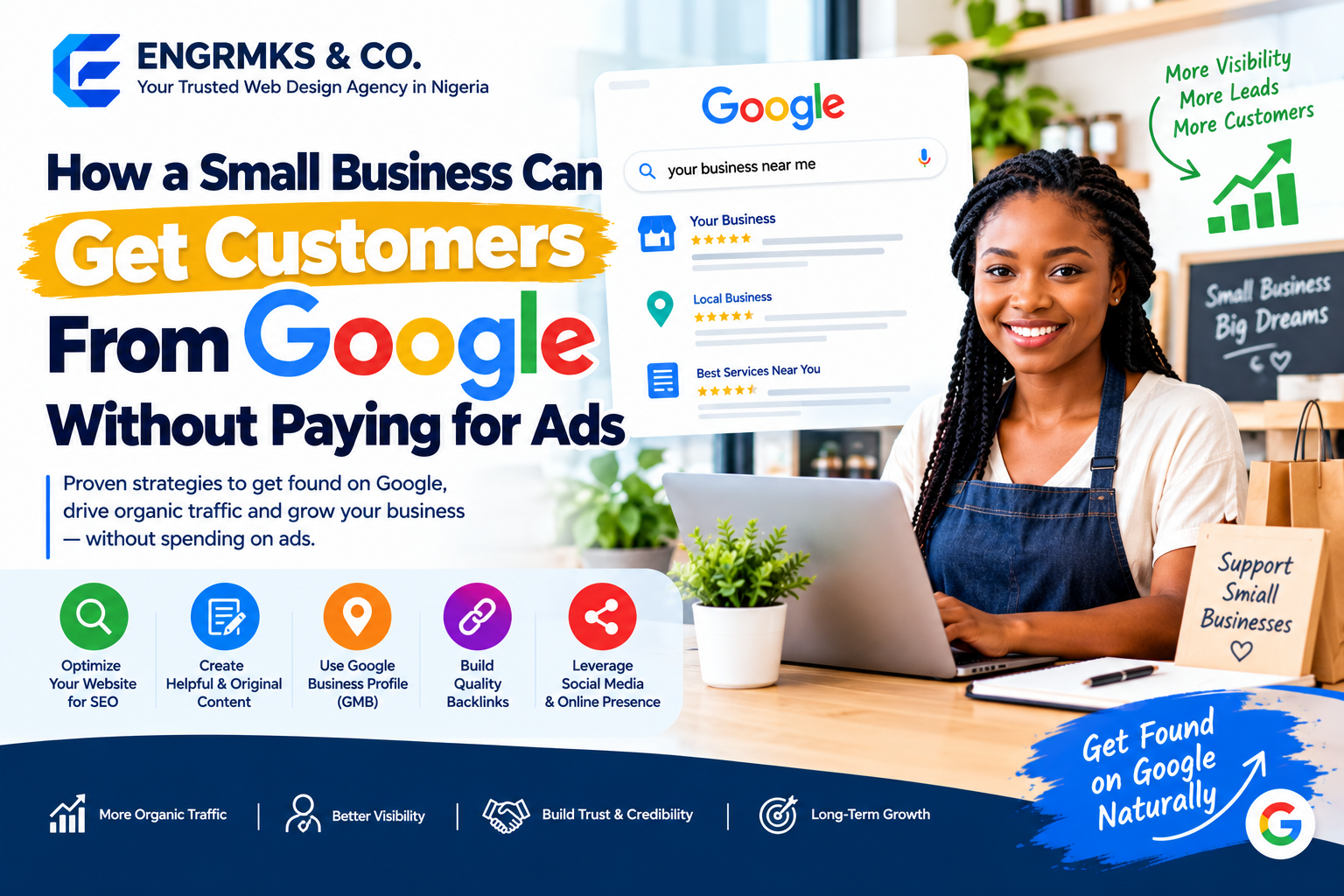
How a Small Business Can Get Customers From Google Without Paying for Ads
For many small businesses, getting customers from Google can seem expensive.
You may see businesses appearing at the top of search results with the word “Sponsored” next to them and assume that you must pay for Google Ads to get customers.
Read also: How to Display and Sell Your Local Products Online in Nigeria (2025 Guide)
That is not necessarily the case.
Small businesses can attract customers from Google through organic search, local search visibility, useful content, a well-optimized website, and a strong online presence—without paying for every click.
This does not mean that organic SEO is completely free. You may invest time, professional services, website development, content creation, or SEO tools. However, you can build long-term organic visibility without paying Google for every visitor.
In this guide, we explain how a small business can get customers from Google without paying for ads, even when competing against larger companies.
1. Create a Website That Google Can Understand
Your website is one of your most important digital assets.
If potential customers search for your products or services, your website should clearly tell Google:
- What your business does.
- Where you operate.
- What products or services you provide.
- Who your customers are.
- How customers can contact you.
For example, if you operate a web design company in Nigeria, don’t simply have a homepage saying:
“Welcome to our website.”
Instead, clearly communicate what you offer:
“Professional Website Design and Development Services in Nigeria.”
Your page titles, headings, text, URLs, images, and internal links should all help search engines and visitors understand your business.
2. Target the Keywords Your Customers Actually Search For
One of the biggest mistakes small businesses make is writing about what they want to say rather than what their customers are searching for.
Imagine you own a printing company.
You might describe your service as:
“Premium Digital Printing Solutions.”
But your potential customer may search Google for:
- Printing company near me
- Business card printing in Kano
- T-shirt printing in Abuja
- Wedding invitation printing
- Banner printing near me
- Affordable printing services
These are potential search intents you can build content around.
Start with customer questions
Think about what your customers ask before buying.
For example:
“How much does website design cost in Nigeria?”
“How can I create a website for my business?”
“What should I put on my business website?”
Each question can potentially become a useful article that brings relevant visitors to your website.
3. Set Up Your Google Business Profile
For businesses that serve customers at a physical location or service a particular geographic area, a Google Business Profile can be extremely important for local visibility.
It can help your business appear in Google’s local results and on Google Maps.
Make sure your profile contains accurate information such as:
- Business name.
- Address or service area.
- Phone number.
- Website.
- Business category.
- Opening hours.
- Services.
- Photos.
- Business description.
Keep the information accurate and consistent.
If your business moves, changes its phone number, or changes its opening hours, update the profile.
4. Get Genuine Customer Reviews
Reviews can help potential customers understand what other customers experienced with your business.
After completing a successful job, you can politely ask the customer to leave an honest review on your Google Business Profile.
Do not buy fake reviews or create reviews pretending to be customers.
Instead, build a process for requesting genuine feedback.
For example, after completing a website project, you could send your client a simple message:
“Thank you for working with us. If you were satisfied with our service, we would appreciate an honest Google review.”
Over time, genuine customer feedback can strengthen your local online presence and give prospective customers more information when evaluating your business.
5. Create Helpful Content
Content marketing is one of the most powerful ways for a small business to attract organic Google traffic.
You don’t need to write about everything.
Write about the problems your potential customers need to solve.
For example, a computer company could publish:
- How to Choose a Laptop for Your Business
- 10 Signs Your Computer Needs an Upgrade
- How to Protect Your Business From Data Loss
- SSD vs HDD: Which Is Better?
- How Much Does a Business Website Cost?
A web development company could publish:
- How to Build a Website That Ranks on Google
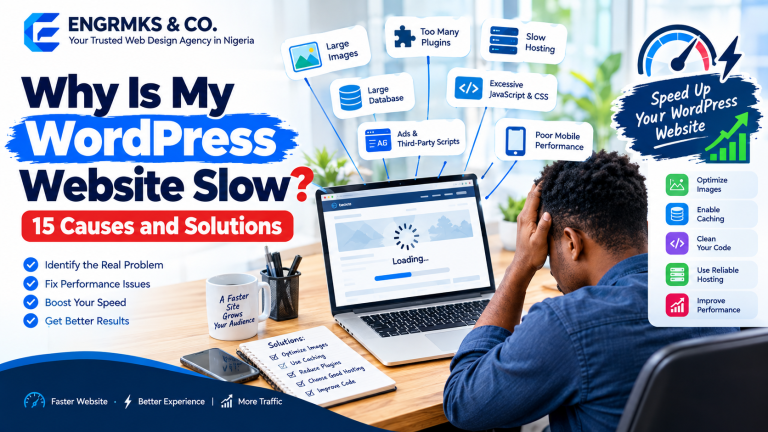
- Why Is My WordPress Website Slow?
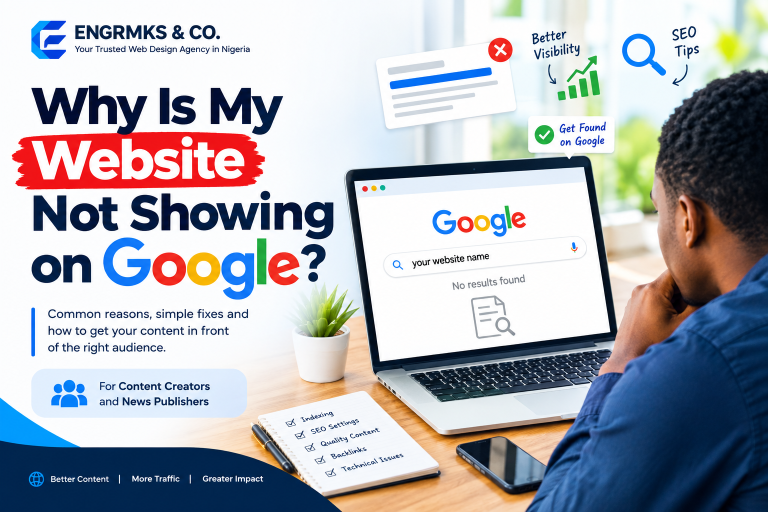
- Why Is My Website Not Showing on Google?
- How Much Does Website Design Cost?
- How to Choose the Right WordPress Theme
These articles can attract people who may eventually become customers.
6. Solve Problems Before Trying to Sell
A common mistake in business blogging is turning every article into an advertisement.
Instead of making every paragraph say:
“Buy our service.”
focus on solving the reader’s problem.
For example, if someone searches:
“Why is my WordPress website slow?”
give them useful information.
Explain:
- Common causes.
- How to test their website.
- How to optimize images.
- How caching works.
- Why hosting matters.
- When professional help may be necessary.
At the end, you can provide a relevant call to action.
This approach allows your business to demonstrate expertise before asking the visitor to become a customer.
7. Create Dedicated Service Pages
Don’t rely entirely on your homepage.
Create individual pages for your major services.
For example, a web development company could have:
- Website Design
- WordPress Development
- E-commerce Website Development
- Mobile App Development
- Website Maintenance
- SEO Services
- Website Speed Optimization
Each service page should clearly explain:
- What the service is.
- Who it is for.
- What problem it solves.
- What is included.
- Why customers need it.
- Frequently asked questions.
- How to get started.
This gives Google more context about the services your business provides.
8. Optimize Your Pages for Local Searches
If your business serves a specific city or region, local SEO can be especially valuable.
Instead of targeting only:
“Website design”
you could target relevant searches such as:
“Website design company in Kano”
or:
“WordPress developer in Abuja.”
However, avoid creating dozens of nearly identical pages simply by replacing one city name with another.
Each location page should provide genuinely useful information relevant to that location.
9. Make Your Website Mobile-Friendly
Many potential customers will discover your business using smartphones.
Your website should therefore work properly on mobile devices.
Check:
- Text size.
- Navigation.
- Buttons.
- Contact forms.
- Images.
- Page speed.
- WhatsApp links.
- Phone links.
- Checkout pages.
A visitor should be able to quickly answer:
What does this business do?
Can they help me?
How do I contact them?
If those answers are difficult to find on a mobile screen, you may lose potential customers.
10. Improve Your Website Speed
A slow website can create a poor user experience.
Small businesses should pay attention to:
- Image sizes.
- Hosting.
- Caching.
- Plugins.
- Themes.
- JavaScript.
- CSS.
- Third-party scripts.
- Database performance.
For WordPress websites, don’t simply install numerous optimization plugins.
First identify the actual performance problem.
You can learn more about this in our guide:
“Why Is My WordPress Website Slow? 15 Causes and Solutions.”
11. Use Internal Links
Internal links connect one page of your website to another.
Suppose you have an article called:
“How Much Does Website Design Cost in Nigeria?”
You could link from that article to:
“How to Build a Website That Ranks on Google.”
You could also link to your:
Website Design Services
page.
This creates a path:
Google Search → Helpful Article → Related Article → Service Page → Contact
That is exactly the type of customer journey a small business website should be designed to support.
12. Earn Quality Backlinks
A backlink is a link from another website to yours.
Quality backlinks can help search engines discover your content and can contribute to your website’s overall authority.
Small businesses can earn links by creating resources that other websites genuinely want to reference.
Examples include:
- Original research.
- Industry statistics.
- Free tools.
- Guides.
- Case studies.
- Expert interviews.
- Useful calculators.
- Original reports.
- Community resources.
Don’t focus on buying hundreds of low-quality links.
Focus on creating something worth referencing.
13. Use Social Media to Amplify Your Content
Social media and Google search serve different purposes, but they can support each other.
When you publish a useful article, share it through:
- Facebook.
- LinkedIn.
- X.
- WhatsApp.
- YouTube.
- Relevant online communities.
Social media exposure can help more people discover your business and content.
For example, if you publish:
“7 Website Mistakes That Make Customers Leave”
you can turn the article into:
- A Facebook post.
- A LinkedIn post.
- A short video.
- An infographic.
- A carousel.
- A WhatsApp status.
- A YouTube Short.
One piece of content can therefore become multiple marketing assets.
14. Build a Strong “About” and “Contact” Page
People don’t only buy products.
They buy from businesses they trust.
Your website should clearly communicate who is behind the business.
Your About page can explain:
Read also: How to Advertise Local Products on WhatsApp (Step-by-Step Guide for Small Businesses)
- Who you are.
- What your business does.
- Your experience.
- Your mission.
- The markets you serve.
- Your approach to customer service.
Your Contact page should make it easy to reach you.
Include relevant options such as:
- Phone.
- Email.
- WhatsApp.
- Contact form.
- Business address.
- Service areas.
- Social media profiles.
15. Create Case Studies
If you have completed successful projects, turn them into case studies.
Instead of simply saying:
“We design websites.”
show what you have accomplished.
A case study could explain:
Client
A small business or organization.
Problem
The client had an outdated website that was difficult to manage.
Solution
You redesigned the website and improved its structure.
Result
The client received a faster, more professional and easier-to-manage website.
Case studies provide potential customers with evidence of what your business can actually do.
16. Answer Frequently Asked Questions
Your customers probably ask the same questions repeatedly.
Turn those questions into website content.
For example:
How much does your service cost?
How long does the project take?
Do you offer maintenance?
Do you work with businesses outside your city?
Do you provide support after delivery?
Creating useful FAQ content can help visitors make decisions faster.
It can also help you target specific long-tail searches.
17. Connect Your Website to Google Search Console
Google Search Console is one of the most useful free tools for monitoring a website’s presence in Google Search.
It can provide information about things such as:
- Search queries.
- Impressions.
- Clicks.
- Indexed pages.
- Search performance.
- Technical issues.
- Sitemap status.
Instead of guessing what people search for, you can use actual search data to improve your content strategy.
For example, you may discover that Google is already showing your website for a particular search query.
You can then improve the relevant page to better answer that searcher’s needs.
18. Create Content Around Long-Tail Keywords
Large companies often compete aggressively for broad keywords.
A small business can sometimes find opportunities in more specific searches.
For example:
Instead of:
“Shoes”
target:
“Affordable men’s leather shoes in Kano.”
Instead of:
“Website design”
target:
“Affordable WordPress website design for small businesses in Nigeria.”
Long-tail searches often reveal more specific customer intent.
The goal is not simply to attract the largest possible number of visitors.
The goal is to attract the right visitors.
19. Keep Your Website Fresh
SEO is not a one-time project.
Your business changes.
Your services change.
Your prices change.
Your contact information changes.
Your customers’ questions change.
Review your important pages regularly.
Update outdated information and improve articles that are no longer comprehensive.
For news publishers and content creators, this becomes even more important because new information can quickly make older content outdated.
20. Turn Google Visitors Into Customers
Getting visitors from Google is only half the job.
You also need to convert visitors into leads and customers.
Every important page should have a clear next step.
Examples include:
Request a Quote
Call Us

Chat on WhatsApp
Book a Consultation
Get a Free Website Audit
Download Our Guide
Contact Our Team
Don’t force the visitor to search through your website to figure out what to do next.
A Simple Free Google Customer Strategy for Small Businesses
If you are starting with a very small budget, follow this simple process:
Step 1: Build a professional website
Make sure your website clearly explains your business and services.
Step 2: Set up your Google Business Profile
Provide accurate business information and keep it updated.
Step 3: Research customer searches
Find questions and phrases your potential customers use.
Step 4: Create helpful content
Publish useful articles that answer those questions.
Step 5: Build service pages
Create dedicated pages for your major products and services.
Step 6: Improve local SEO
Target relevant locations where you actually operate or provide services.
Step 7: Get genuine reviews
Encourage satisfied customers to provide honest feedback.
Step 8: Build internal links
Connect your articles, service pages and contact pages.
Step 9: Promote your content
Share your articles through social media and relevant communities.
Step 10: Measure the results
Use Google Search Console and other analytics tools to understand what is working.
How Long Does It Take to Get Customers From Google?
There is no guaranteed timeframe for organic SEO.
A new website may take time to establish visibility, while an established website with useful content and existing authority may see results sooner.
The amount of competition, quality of the website, content, location, industry, search demand, technical SEO, and many other factors can influence results.
Therefore, don’t approach SEO as:
“I published an article today, so I should get customers tomorrow.”
Think of it as building a digital asset that can continue attracting potential customers over time.
Can a Small Business Really Compete With Large Companies?
Yes, but the strategy should be smart.
A small business does not necessarily need to compete for every broad keyword.
Instead, focus on your:
- Location.
- Industry.
- Specific services.
- Customer problems.
- Expertise.
- Unique experience.
- Niche.
A small business that understands its customers can create extremely relevant content for specific searches.
For example, instead of trying to rank for the enormous keyword:
“Web Design”
a small Nigerian agency could create useful content around searches such as:
“How much does a business website cost in Nigeria?”
or:
“How to choose a WordPress developer for your business.”
The objective is to attract people who are genuinely relevant to the business.
Frequently Asked Questions
Can I get customers from Google without Google Ads?
Yes. Businesses can attract customers through organic search and local search without paying Google for each click. However, organic visibility requires time, useful content, technical optimization, and ongoing effort.
Is SEO free for small businesses?
Organic search traffic does not require paying Google for every click, but SEO itself can require investment in website development, content, tools, technical work, or professional services.
How can I get my small business on Google?
Create a professional website, set up your Google Business Profile where applicable, publish useful content, optimize your pages for relevant searches, maintain accurate business information, and monitor your search performance.
How do I get my business to appear on Google Maps?
For eligible businesses, creating and maintaining a Google Business Profile is an important part of establishing a local presence on Google.
Should a small business have a blog?
A blog can be useful when it is used strategically to answer questions potential customers actually ask. You do not need to publish every day; focus on useful, relevant content.
Do Google reviews help small businesses?
Genuine reviews can provide potential customers with useful information about a business and are an important part of a local business’s online presence. Businesses should seek honest reviews rather than manipulating or purchasing them.
Final Thoughts
You do not need a huge advertising budget to start attracting customers from Google.
A small business can build organic visibility by creating a useful website, understanding what customers search for, publishing helpful content, improving local visibility, earning genuine reviews, building relevant links, and making it easy for visitors to contact the business.
The key is consistency.
Instead of asking:
“How much should I spend on Google Ads?”
also ask:
“What can I build today that Google can continue sending customers to months or years from now?”
A well-optimized service page, useful article, detailed case study, local business profile, or helpful guide can continue working as part of your digital marketing system long after it is published.
Build useful content. Solve real customer problems. Make your business easy to find. Make it easy to contact you.
That is how a small business can build a sustainable source of customers from Google without paying for every click.
Need a Website That Brings You Customers From Google?
Your website should do more than simply look professional—it should help potential customers find your business, understand your services and take action.
Read also: WhatsApp Marketing for Nigerian Entrepreneurs: A Complete Guide
ENGRMKS & CO. helps businesses build professional, SEO-friendly websites designed to attract visitors and generate leads.