How to Structure Categories on a Nigerian News Website
The way you structure categories on a Nigerian news website can have a major impact on how easily readers find stories, how efficiently your editorial team organizes content and how clearly search engines understand your website.
A growing online newspaper can quickly accumulate thousands of articles covering politics, business, sports, entertainment, technology, education, health, crime and local communities. Without a logical category structure, important stories can become difficult to find, navigation can become confusing and the website can develop large numbers of unnecessary or overlapping archive pages.
A good category structure should therefore serve both readers and search engines.
Google’s current guidance emphasizes creating people-first websites that provide useful, satisfying experiences rather than creating pages primarily to manipulate search rankings. Google also says there is no preferred word count for ranking, which means publishers should focus on covering a subject appropriately rather than writing to an arbitrary length.
For Nigerian publishers using WordPress or another content management system, the following structure provides a practical starting point.
Why Categories Matter on a Nigerian News Website
Categories are more than labels attached to articles.
They help create an information architecture that tells readers where different types of content belong.
For example, a newspaper might publish stories about:
- Nigerian politics
- Federal Government
- State governments
- Business
- Banking
- Agriculture
- Sports
- Entertainment
- Technology
- Education
- Health
- Crime
- Metro
- International news
If these topics are mixed together without a clear system, readers may struggle to navigate the website.
A well-planned category structure makes it easier to answer a simple question:
“Where should this story belong?”
It also makes it easier for editors, reporters and content managers to maintain consistency as the publication grows.
The Recommended Main Categories for a Nigerian News Website
There is no single category structure that every Nigerian newspaper must use. Your categories should reflect your publication’s editorial focus and audience.
However, a general Nigerian online newspaper can start with a structure such as:
1. News
The main News section can cover major general-interest developments.
Possible subcategories include:
- National
- Metro
- State News
- Local News
- Crime
- Investigations
2. Politics
Politics is often a major section for Nigerian publications.
Possible subcategories include:
- National Politics
- Presidency
- National Assembly
- Political Parties
- Elections
- State Politics
- Local Government
If your newspaper frequently reports political developments, giving Politics its own top-level category can make sense.
3. Business
Business content can be organized into areas such as:
- Economy
- Banking & Finance
- Markets
- Entrepreneurship
- Agriculture
- Energy
- Real Estate
- Small Business
The exact structure should depend on the volume of stories your newsroom actually produces.
4. Sports
A sports-focused newspaper might use:
- Football
- Kano Pillars
- Super Eagles
- NPFL
- International Football
- Basketball
- Athletics
- Tennis
- Other Sports
Do not create every possible sports category simply because it exists. A category should ideally have enough relevant content to justify its existence.
5. Entertainment
Possible subcategories include:
- Nollywood
- Music
- Celebrity
- Television
- Events
- Lifestyle
6. Technology
Technology could include:
- Gadgets
- Artificial Intelligence
- Cybersecurity
- Telecoms
- Startups
- Digital Economy
7. Education
Possible subcategories include:
- Universities
- Polytechnics
- Schools
- Admissions
- Scholarships
- JAMB
- WAEC
- NECO
8. Health
A health section could include:
- Public Health
- Medical Research
- Wellness
- Nutrition
- Hospitals
- Health Policy
For health content, publishers should pay particular attention to accuracy, sourcing and author expertise because Google places greater emphasis on trust for topics that can significantly affect people’s well-being.
Should Nigerian News Websites Use State-Based Categories?
This is one of the most important structural decisions for a Nigerian publisher.
Nigeria has 36 states and the Federal Capital Territory, but that does not mean every news website should automatically create 37 top-level categories.
Creating a separate category for every state can produce a large number of thin or poorly populated archive pages if the newsroom does not publish enough content for each location.
Instead, consider your actual editorial coverage.
For example:
News
- Abuja
- Kano
- Kaduna
- Lagos
- Rivers
- Katsina
- Plateau
could be appropriate if these are important areas of coverage.
Another publication may need a broader:
State News
- North West
- North East
- North Central
- South West
- South East
- South South
structure.
The best choice depends on your publication’s reporting footprint.
Avoid Creating Too Many Categories
One of the most common mistakes on news websites is creating a new category for almost every topic.
For example:
- Politics
- Nigerian Politics
- Nigeria Politics
- Political News
- Government
- Government News
- Political Affairs
These may overlap heavily.
Instead, decide what the primary editorial classification should be and use tags or topics for additional context where appropriate.
A useful rule is:
Categories should represent major sections of your publication; tags can provide more specific descriptive context.
This creates a cleaner taxonomy and reduces unnecessary duplication.
Categories vs Tags: What Is the Difference?
Categories and tags should have different jobs.
Categories
Categories answer:
“What major section of the newspaper does this story belong to?”
Examples:
- Politics
- Business
- Sports
- Entertainment
- Technology
Tags
Tags answer:
“What specific people, places, subjects or themes are associated with this story?”
For example, an article about a Nigerian government economic policy could have:
Category: Business
Tags: Federal Government, Economy, Abuja, Economic Policy
Another article could belong to:
Category: Politics
Tags: Presidency, National Assembly, Political Party, Abuja
Do not turn every tag into an indexable page simply because WordPress allows it.

Use a Clear Category Hierarchy
A good hierarchy should be easy to understand.
For example:
Politics
→ Presidency
→ National Assembly
→ Elections
→ State Politics
Business
→ Banking
→ Economy
→ Agriculture
→ Energy
Sports
→ Football
→ Super Eagles
→ NPFL
→ Athletics
This gives the newsroom a consistent editorial framework.
Google’s breadcrumb guidance notes that breadcrumb trails can help users understand a page’s position within a site’s hierarchy and navigate upward through that structure.
Keep Category URLs Simple
Your category URLs should be predictable and easy to understand.
For example:
example.com/politics/
example.com/business/
example.com/sports/
example.com/entertainment/
For subcategories:
example.com/politics/elections/
example.com/business/banking/
example.com/sports/football/
Avoid unnecessarily complicated URLs containing multiple parameters or meaningless numbers.
More importantly, do not repeatedly change established URLs without a good reason. If a URL must change, make sure appropriate redirects and internal-link updates are implemented.
Write Useful Category Descriptions
A category page should not simply display a list of headlines.
Where appropriate, provide a short introduction explaining what readers will find in the section.
For example:
Politics
“Read the latest Nigerian political news, including developments from the Presidency, National Assembly, political parties, elections and state governments.”
This gives users immediate context.
It can also help search engines understand the purpose of the page.
However, avoid stuffing category descriptions with repeated keywords. Write naturally for readers.
Make Category Pages Useful Destinations
A category page should provide genuine navigation value.
Consider including:
- A clear category title
- Short introduction
- Featured story
- Latest stories
- Pagination or appropriate loading
- Relevant subcategories
- Breadcrumbs
- Search functionality
- Related topic links
The objective should be to make the category page useful to someone who wants to explore that subject.
Google’s guidance encourages publishers to create content and pages that satisfy users rather than pages created primarily to attract search-engine traffic.
Create a Consistent Navigation Menu
Your main navigation should contain the most important sections of the newspaper.
For example:
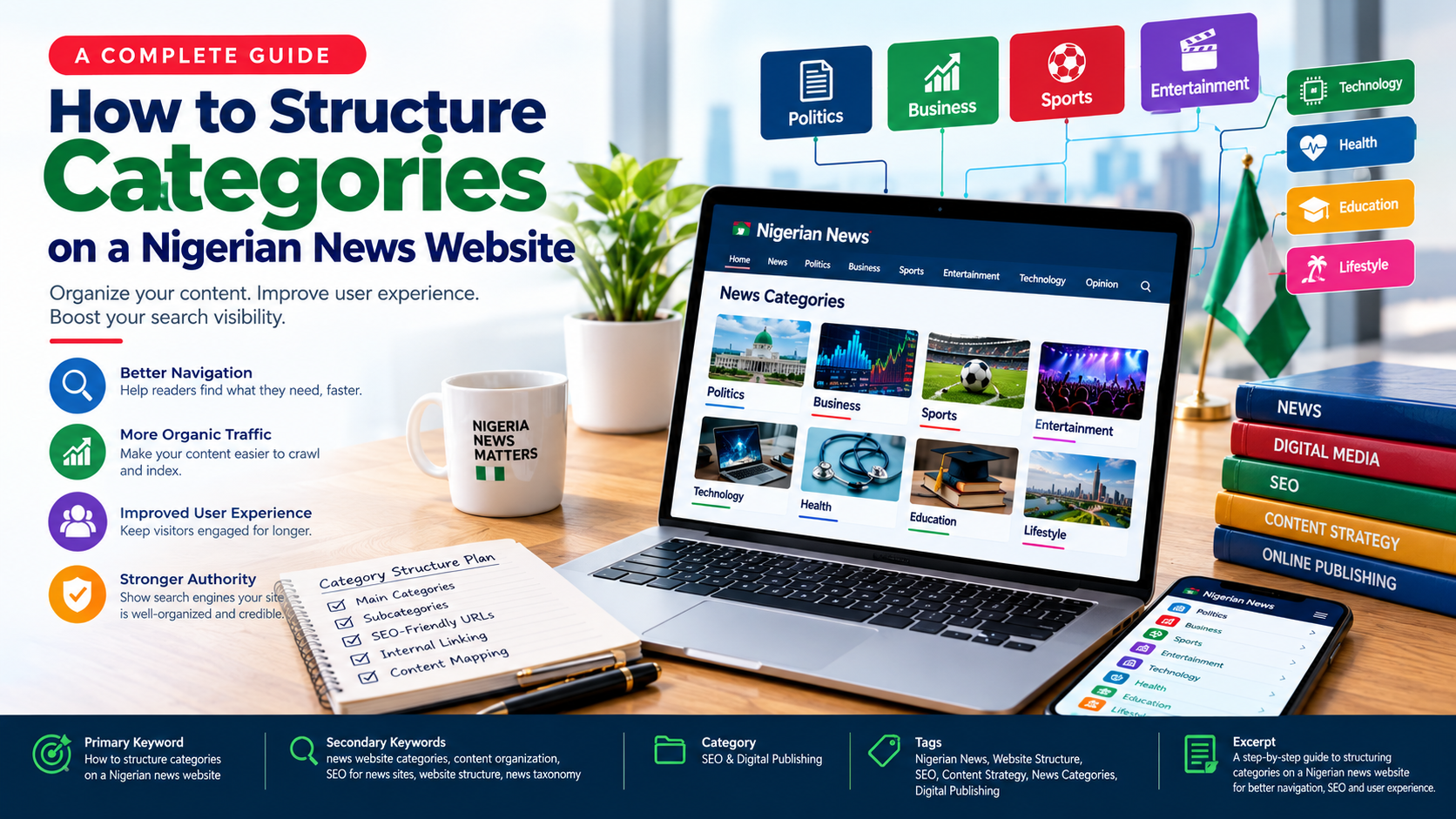
Home | News | Politics | Business | Sports | Entertainment | Technology | Health | Education
A “More” menu can contain less prominent sections.
Do not place 30 or 40 categories directly in the primary navigation.
The menu should help readers find important sections quickly.
Use Internal Linking Between Related Categories
Internal linking can strengthen the relationship between different parts of your website.
For example, a story about a government technology initiative might belong to:
Technology
but could also link to relevant:
- Politics stories
- Business coverage
- Education stories
- Previous reports
Internal links should be useful and relevant rather than inserted solely for SEO purposes.
Think About Search Intent When Naming Categories
Use names your audience actually understands.
For example:
Business
is generally clearer than:
Corporate & Commercial Affairs
unless the latter accurately reflects your publication’s editorial positioning.
Similarly:
Sports
is immediately understandable, while an unusual alternative may require readers to think about what the section contains.
Simple category names make navigation easier.
Avoid Duplicate Category Concepts
Before creating a new category, ask:
- Does this topic already have a category?
- Could it be a subcategory?
- Would a tag be more appropriate?
- Will the newsroom publish enough stories under it?
- Will readers actually use this section?
- Does it overlap significantly with another category?
For example, creating both Crime and Criminal News may create unnecessary overlap.
Choose one clear classification and apply it consistently.
Use Breadcrumbs
Breadcrumbs are particularly useful for websites with multiple levels of content.
A story could display:
Home → News → Politics → Article
or:
Home → Business → Banking → Article
Breadcrumbs give readers context and make it easier to move back through the site’s hierarchy.
Google supports Breadcrumb structured data, which can help it understand the page’s position within the website structure.
Consider SEO-Friendly Category Architecture in WordPress
For a WordPress Nigerian news website, a practical structure might look like:
Home
- News
- National
- Metro
- Crime
- State News
- Politics
- Presidency
- National Assembly
- Elections
- Business
- Economy
- Banking
- Agriculture
- Energy
- Sports
- Football
- NPFL
- Super Eagles
- Entertainment
- Nollywood
- Music
- Celebrity
- Technology
- Gadgets
- AI
- Telecoms
- Education
- Health
- Opinion
This is only a starting framework. Your final taxonomy should reflect the stories your newsroom actually publishes.
Should Every Category Be Indexed by Google?
Not necessarily.
The objective should not be to make every automatically generated WordPress archive searchable.
Review category, tag, author, date and search-result pages individually.

A useful category with substantial content and genuine navigation value may deserve to be discoverable in search.
A thin archive containing only a handful of posts may provide little value.
Google’s broader guidance emphasizes useful, substantial and satisfying content rather than creating large numbers of pages primarily for search traffic.
Review Your Categories Regularly
News organizations change.
A category that made sense two years ago may no longer be necessary. Another topic may become important enough to deserve its own section.
Conduct a category audit every few months.
Check:
- Number of articles in each category
- Duplicate or overlapping categories
- Empty categories
- Thin category pages
- Broken links
- Navigation usability
- Category URLs
- Internal linking
- Breadcrumbs
- Search Console performance
- Reader behavior
Do not change categories simply because you believe a different structure will automatically improve rankings. Make structural changes when they improve organization, usability or the clarity of your publication.
Recommended Category Structure for a General Nigerian News Website
For publishers looking for a practical starting point, the following structure can work well:
Main Categories
- News
- Politics
- Business
- Sports
- Entertainment
- Technology
- Education
- Health
- Opinion
- Lifestyle
Possible Subcategories
News: National, Metro, Crime, State News, Investigations
Politics: Presidency, National Assembly, Elections, Political Parties, State Politics
Business: Economy, Banking, Agriculture, Energy, Markets, Entrepreneurship
Sports: Football, NPFL, Super Eagles, Basketball, Athletics
Entertainment: Nollywood, Music, Celebrity, Television
Technology: Gadgets, AI, Telecoms, Cybersecurity, Startups
Education: Universities, JAMB, WAEC, Scholarships, Schools
Health: Public Health, Wellness, Medical News, Health Policy
Opinion: Editorial, Columns, Analysis, Commentary
The key is not to copy this structure blindly. Adapt it to your publication’s editorial mission and the topics your readers actually consume.
Final Category Structure Checklist
Before launching or restructuring your Nigerian news website, ask:
☐ Are the main categories immediately understandable?
☐ Does every major content area have a logical home?
☐ Are categories different from tags?
☐ Are there unnecessary duplicate categories?
☐ Are there too many top-level categories?
☐ Are important sections accessible from the main navigation?
☐ Are category URLs clean and consistent?
☐ Do category pages contain useful content?
☐ Are breadcrumbs implemented where appropriate?
☐ Are internal links helping readers discover related stories?
☐ Are thin or empty archive pages being controlled?
☐ Is the category structure easy for editors to maintain?
☐ Does the structure reflect the publication’s actual editorial focus?
☐ Is the website mobile-friendly and easy to navigate?
☐ Are changes being measured through analytics and Search Console?
Conclusion
A well-structured category system gives a Nigerian news website a clear editorial architecture.
Instead of creating dozens of categories simply because WordPress makes it easy, start with the major subjects your newsroom consistently covers. Build a small number of strong top-level categories, introduce subcategories only where they provide genuine organizational value, and use tags for more specific subjects.
The goal is simple: help readers find the news they want while giving search engines a clear understanding of how your publication is organized.
A strong category structure should therefore be simple, logical, scalable and reader-focused.
And remember: category architecture is only one part of SEO. Google evaluates many signals, and its current guidance emphasizes helpful, reliable, people-first content rather than pages created primarily to manipulate rankings.
For a Nigerian online newspaper, the strongest long-term approach is to combine a clean website structure with original journalism, clear authorship, accurate reporting, strong internal linking, fast performance, mobile usability and consistent editorial quality.