How to Find Keywords for a Nigerian Business Website
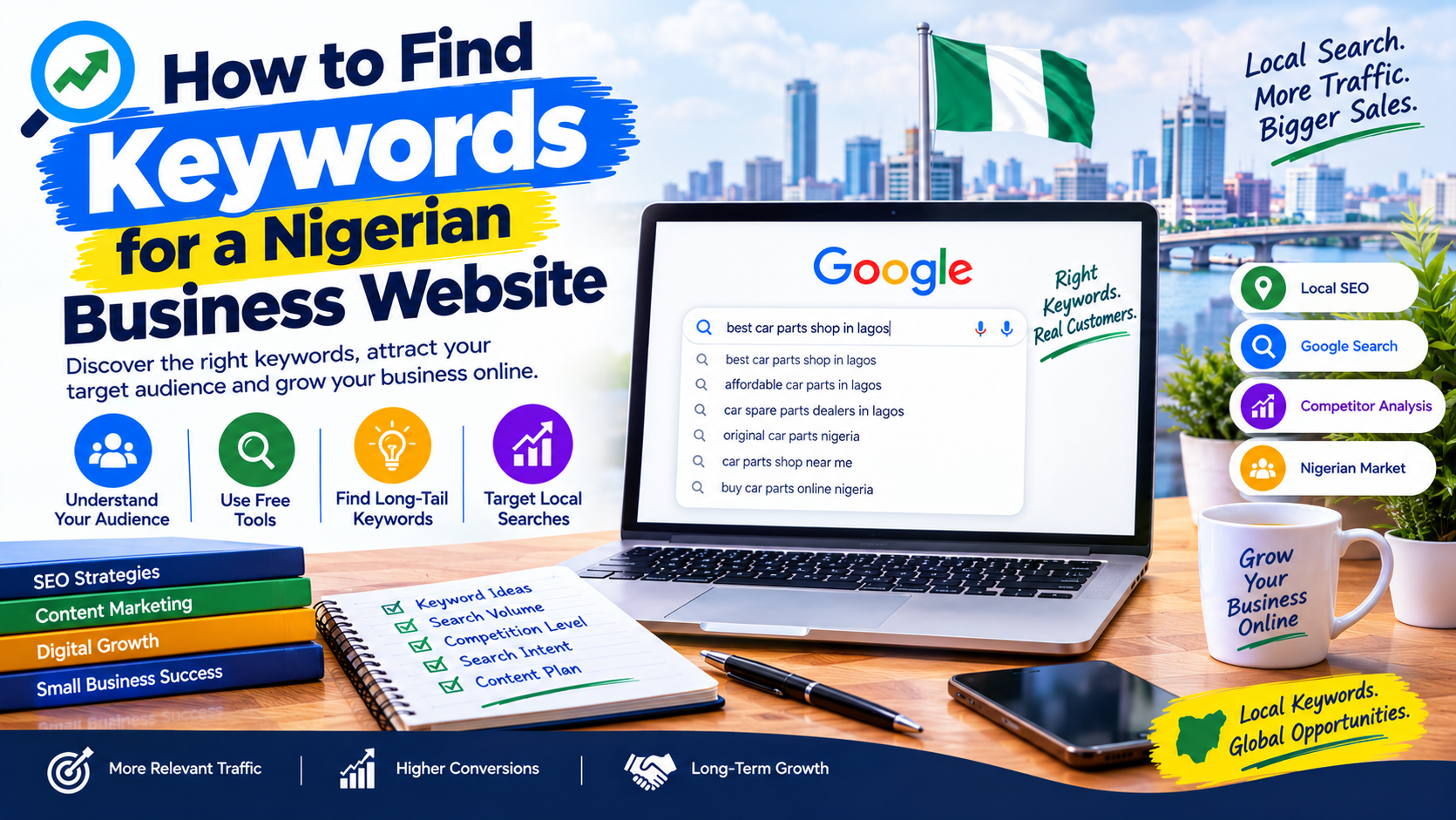
If you own a business in Nigeria and want more customers to find your website on Google, keyword research is one of the most important SEO activities to learn. The right keywords help you understand what potential customers are searching for and how to create website content that answers their needs.
For example, someone looking for a web designer might search for “website design company in Kano,” while another person may search for “affordable website design in Nigeria.” A business that understands these search phrases can build more relevant service pages, blog posts, and landing pages.
You do not necessarily need expensive SEO software to get started. By using Google Search, Google Trends, Google Search Console, and information from your customers, you can identify useful keyword opportunities for your business.
In this guide, you will learn how to find keywords for a Nigerian business website, select relevant search terms, target local customers, and use your findings to improve your website’s SEO.
What Are Keywords in SEO?
Keywords are the words and phrases people enter into search engines when looking for information, products, or services.
For a Nigerian business website, keywords might include:
- Website design company in Kano
- Affordable catering services in Abuja
- Solar installation company in Lagos
- Best printing services in Kaduna
- Computer repair services in Nigeria
- Buy office furniture in Port Harcourt
These examples represent different products, services, and locations. The most appropriate keywords depend on your business, your customers, and the services you actually provide.
Keyword research involves discovering these phrases, understanding what searchers want, and deciding which ones deserve dedicated pages or content on your website.
Why Is Keyword Research Important for Nigerian Businesses?
Keyword research helps you make informed decisions about your website content instead of guessing what potential customers might search for.
Here are some of its major benefits.
1. It Helps You Reach the Right Customers
A website may attract visitors without generating enquiries or sales if its content targets the wrong searches.
For example, a company offering professional web design may receive little business from visitors looking only for free website templates.
Researching search intent helps you distinguish people seeking general information from those looking to hire a service provider.
2. It Improves Local Search Visibility
Many businesses serve customers in particular cities, states, or neighbourhoods.
Including relevant location information can help explain where your business operates.
For example, a business that genuinely serves Kano could create a service page targeting “website design services in Kano.”
Only target locations you actually serve, and avoid creating many nearly identical pages that provide no additional value.
3. It Helps You Plan Useful Content
Keyword research can reveal questions your customers ask before making a purchase.
A solar installation company, for example, might publish guides explaining solar system options, installation processes, maintenance, and factors that affect costs.
These articles can help potential customers understand the service and discover the business through relevant searches.
4. It Helps You Use Your SEO Resources Wisely
Small businesses often have limited budgets for marketing.
Keyword research helps prioritise topics that are relevant to the business, realistic to target, and likely to attract the right audience.
Step 1: Understand Your Customers and Services
Before using any keyword tool, write down what your business offers and who is most likely to buy from you.
Ask yourself:
- What products or services do I provide?
- Who needs these products or services?
- What problems do my customers want to solve?
- Which cities or areas do I serve?
- What questions do customers ask before buying?
- What words do customers use when describing my services?
For example, an accounting firm might identify these core services:
- Tax preparation
- Bookkeeping
- Business accounting
- Payroll services
- Financial reporting
Each service can become a starting point for keyword research.
Practical tip: Use the language your customers naturally use. Technical terms may be appropriate for some audiences, while straightforward descriptions may work better for others.
Step 2: Start With Google Search Suggestions
Google Search is a useful starting point for discovering keyword ideas.
Enter a basic phrase related to your business and observe the suggestions that appear as you type.
For example, a catering business might start with:
- Catering services in…
- Affordable catering…
- Event catering…
- Wedding catering…
- Corporate catering…
Try different combinations of services, customer needs, and locations.
You can also examine the related questions and searches shown on the results page where available. These can reveal additional topics worth investigating.
Remember that suggestions are ideas to research, not proof that a phrase has high search volume or low competition.
Step 3: Use Google Trends to Explore Nigerian Search Interest
Google Trends helps you compare search interest over time and investigate related searches.
Visit Google Trends and enter a keyword related to your business. Where the available filters permit, select Nigeria as the location and choose a suitable time range.
For example, you could compare different phrases for a business service to see how their relative search interest changes.
Use Trends to investigate:
- Whether interest in a topic is increasing or decreasing
- Related search terms
- Differences in interest across available regions
- Seasonal patterns
- Emerging topics relevant to your customers
Google Trends provides relative search-interest data rather than exact monthly search counts. Use it to compare patterns and discover ideas, not to assume a particular phrase will produce a specific number of visitors.
Its related-search sections include popular and rising queries, which can help expand your initial list of keyword ideas. https://support.google.com/trends/answer/4355000
Step 4: Find Long-Tail Keywords
Long-tail keywords are more specific search phrases that often describe a particular need.
Compare these examples:
| Broad keyword | More specific keyword |
|---|---|
| Web design | Affordable web design company in Kano |
| Catering | Corporate catering services in Abuja |
| Solar installation | Solar panel installation for homes in Lagos |
| Printing | Business card printing services in Kaduna |
| Computer repair | Laptop repair services in Port Harcourt |
The longer phrase is not automatically easier to rank for, and some long-tail terms may have very little search demand. However, specific phrases can help you understand the searcher’s needs more clearly.
For a small business, a highly relevant phrase may be more valuable than a broad term that attracts visitors who are unlikely to become customers.
Build a list of specific phrases based on the services you provide, the questions customers ask, and the locations you serve.
Step 5: Research Local Keywords for Your Business
Local keyword research is especially useful for businesses that serve customers in a particular geographical area.
Combine your service with a relevant location or customer need.
For example:
- Plumber in Kano
- Event planner in Abuja
- Bakery in Kaduna
- Cleaning services in Lagos
- Office furniture supplier in Ibadan
- Website maintenance services in Nigeria
These are examples, not verified rankings or search-volume recommendations.
Choose locations based on your actual service area. If you serve customers throughout Nigeria, national keywords may be appropriate. If you operate only in one city, focus on that market first.
You should also set up and maintain a Google Business Profile if your business is eligible. Keep your business name, address or service area, contact details, and operating information accurate.
Local SEO involves more than keywords. Your business information, relevance to the search, reputation, and website quality can all matter.
Step 6: Study Competitor Websites
Competitor research can help you discover topics and services you may have overlooked.
Identify a few genuine competitors that offer similar products or services to the same audience.
Review their websites and look for:
- Main service pages
- Product categories
- Frequently asked questions
- Helpful blog posts
- Location-specific service pages
- Customer problems they address
- Topics that appear repeatedly across their content
For example, if several reputable web design companies explain website maintenance, hosting, and website security, those subjects may be relevant to your own audience too.
Do not copy competitor content or assume that every keyword they use is valuable. Assess whether the topic fits your services and whether you can create a more useful, accurate page.
Step 7: Use Google Search Console to Find Existing Keyword Opportunities
If your website is already appearing in Google Search, Google Search Console can reveal actual queries that have displayed your pages.
Open Google Search Console and select your website property.
Then:
- Open the Search results Performance report.
- Select a suitable date range.
- Review the Queries tab.
- Check impressions, clicks, click-through rate, and average position.
- Examine the Pages tab to see which pages appear for relevant searches.
- Identify relevant queries that could benefit from better content or clearer page titles.
For example, your website might already receive impressions for a phrase related to one of your services, even if you have not deliberately targeted it.
That can be an opportunity to improve the existing page, answer the searcher’s question more fully, or create a separate page if the intent is genuinely different.
Search Console reports provide information about your website’s actual search performance, including queries, clicks, impressions, and other metrics. Some queries may not appear in reports, so the available data is not necessarily a complete list of every search. https://support.google.com/webmasters/answer/10268906
Step 8: Consider Free and Low-Cost Keyword Tools
You can begin keyword research without purchasing an expensive SEO subscription.
Useful starting points include:
- Google Search: Discover autocomplete suggestions and related questions.
- Google Trends: Compare search interest and explore related queries.
- Google Search Console: Review queries already bringing impressions and clicks to your website.
- Google Keyword Planner: Explore keyword ideas and available search estimates through Google Ads.
- Customer enquiries: Learn the exact language customers use when describing their needs.
Some Keyword Planner features or estimates may require completing Google Ads account setup and providing billing information. Review the requirements before signing up, and remember that estimated search volumes are not guarantees of traffic.
You do not need to use every tool. Start with the resources that answer your immediate questions.
Step 9: Understand Search Intent
Search intent is the reason behind a person’s search.
Understanding intent helps you decide what kind of page to create.
Four useful categories are:
Informational intent: The searcher wants to learn something.
Example: “How does solar power work?”
Commercial investigation: The searcher is comparing options.
Example: “Best solar installation companies in Abuja.”
Transactional intent: The searcher is ready to take action or buy.
Example: “Hire a solar installer in Abuja.”
Navigational intent: The searcher is looking for a particular business or website.
Example: A search for a known company’s name.
Your service pages should clearly explain what you offer and how customers can contact you. Informational searches may be better served by useful guides, comparisons, and answers to common questions.
Do not force every keyword into a sales page. Match the content to what the searcher wants.
Step 10: Organise Keywords Into Website Pages
Once you have collected keyword ideas, organise them into groups based on search intent and topic.
For example, a digital agency might use this structure:
| Website page | Keyword focus |
|---|---|
| Homepage | Digital marketing agency in Nigeria |
| Web design service | Website design company in Kano |
| SEO service | SEO services for Nigerian businesses |
| Website maintenance service | Website maintenance services in Nigeria |
| Blog article | How to improve a business website’s SEO |
These are illustrative examples. Select phrases that reflect your real services and target market.
Avoid creating a separate page for every minor variation of the same keyword. If several phrases express the same intent, one strong page may be enough.
Use a spreadsheet to record the keyword, intended page, search intent, location, and next action. You can add search-volume and competition estimates when reliable data is available.
Step 11: Choose Keywords You Can Realistically Target
Not every keyword is equally useful to your business.

Prioritise phrases using these questions:
- Is the keyword relevant to my products or services?
- Does it match what my intended customers want?
- Is the search local or national, as appropriate?
- Can I create a useful page that answers the query?
- Does my website already have a relevant page?
- Can I differentiate my content from competing results?
Search volume can be useful, but it should not be the only deciding factor. A lower-volume phrase that attracts relevant potential customers may be more valuable than a broad phrase that generates unqualified visits.
Competition is also difficult to judge from a single metric. Review the actual search results and consider whether your business can provide something more useful or relevant.
Common Keyword Research Mistakes to Avoid
Targeting Only Broad Keywords
Broad phrases may be competitive and may not communicate a clear buying need. Investigate specific services and customer questions as well.
Ignoring Local Search Intent
If your business serves a defined area, location-specific terms may be important. Use them naturally and accurately.
Choosing Keywords Without Understanding Intent
A page targeting an informational query may not satisfy someone looking to hire a service immediately.
Stuffing Keywords Into Every Paragraph
Repeatedly inserting the same phrase can make content difficult to read. Use your main keyword naturally in the title, introduction, relevant headings, and body where it fits.
Copying Competitors
Competitor research should inspire useful ideas, not lead to copied content. Explain your own services, experience, process, and customer benefits.
Ignoring Performance Data
Keyword research is an ongoing process. Review your website’s results and improve pages based on what you learn.
A Simple Keyword Research Plan for Nigerian Businesses
To get started, follow this practical plan:
Day 1: List your services, customers, and target locations.
Day 2: Use Google Search to collect keyword suggestions and customer questions.
Day 3: Explore Google Trends and compare relevant search topics for Nigeria.
Day 4: Review competitor websites and note missing topics that fit your business.
Day 5: Use Search Console, if available, to discover queries already associated with your website.
Day 6: Group keywords by search intent and assign them to suitable pages.
Day 7: Improve one important service page or publish one useful article based on your research.
Continue reviewing your results and updating your plan as your business and customer needs evolve.
Frequently Asked Questions
What is the best free keyword research tool for Nigerian businesses?
Google Search, Google Trends, and Google Search Console are useful starting points. Google Keyword Planner can also provide keyword ideas and estimates, although account setup requirements may apply.
How many keywords should I target on one page?
There is no universal number. Focus on one clear primary topic and naturally cover closely related phrases that help answer the same search intent.
Should I include “Nigeria” in every keyword?
No. Include a country, city, or neighbourhood when it accurately reflects the audience and search intent. Repeating location names unnecessarily can make content unnatural.
Can keyword research improve website traffic?
Keyword research can help you create more relevant pages and reach people searching for your services. Actual traffic depends on many factors, including competition, content quality, indexing, website usability, and search demand.
How often should I update my keyword research?
Review it periodically and whenever your services, target market, or customer needs change. Use Search Console to identify new queries and opportunities for improving existing pages.
Conclusion
Learning how to find keywords for a Nigerian business website does not require an expensive SEO budget. You can begin by understanding your customers, using Google Search suggestions, exploring Google Trends, studying competitors, and reviewing your website’s Search Console performance.
The most important step is to choose relevant keywords that match your services, your target locations, and the needs of potential customers.
Organise your findings into a clear website structure, create helpful service pages and articles, and review your results over time.
Start with the keywords most closely connected to your business and the customers you want to reach. A focused, useful SEO strategy is a stronger foundation for long-term growth than chasing popular keywords that have little relevance to your business.