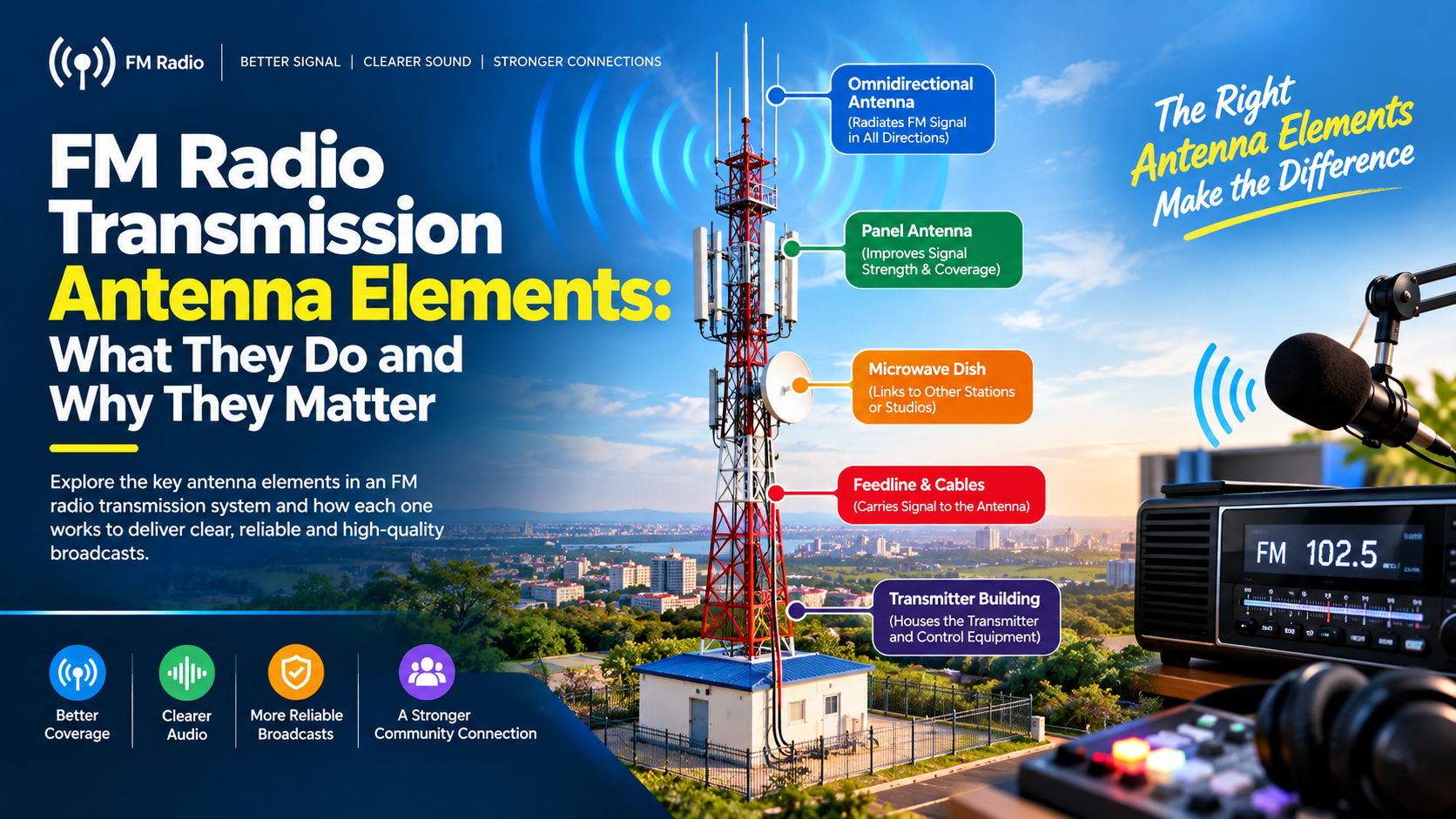
FM Radio Transmission Antenna Elements: What They Do and Why They Matter
If you have ever looked at the top of an FM radio tower and wondered why some stations have one antenna element while others have four, six, eight or even more, the answer lies in antenna array engineering.
Those elements are often not separate antennas working independently. In many broadcast installations, they form an antenna array—multiple radiating elements that are fed and controlled in a specific way to produce the desired electromagnetic radiation pattern.
For FM broadcasters, the number of antenna elements, their spacing, height, phase, amplitude, polarization and feed system can all influence how radio-frequency (RF) energy is distributed around the station.
One important point, however, is that more antenna elements do not automatically mean more transmitter power. Instead, a properly designed array allows engineers to control how the available RF energy is distributed in space.
What Are FM Radio Antenna Elements?
An antenna element is a radiating component used to transmit electromagnetic energy. In an FM broadcast installation, multiple elements may be positioned vertically along a tower or supporting structure.
These vertically arranged elements are commonly referred to as bays. A station may therefore have a single-bay antenna system, two bays, four bays, six bays, eight bays or more, depending on the required design and coverage objectives.
The elements are connected to the transmitter through a transmission-line and feed system. In a multi-element installation, RF power can be distributed between the individual antenna bays using a power divider or related feed arrangement.
The result is not simply “more antennas.” It is a coordinated system designed to control the way RF energy leaves the antenna.
Single-Element FM Antenna
A single-element antenna is one of the simplest arrangements used for radio transmission.
Its major advantages include:
- Simple construction
- Lower installation cost
- Easier maintenance
- Relatively simple feed system
- Lower wind loading
- Suitability for smaller coverage requirements
However, a single element gives engineers less control over the radiation pattern than a properly designed multi-element array. For vertically polarized FM broadcasting, one of the objectives can be to distribute energy efficiently toward the horizon around the station.
Read also: How to Create a Radio Station Mobile App: A Step-by-Step Guide
What Happens When a Radio Station Uses Two Antenna Elements?
With two antenna elements separated vertically, engineers can feed both elements with the same RF signal while carefully controlling their phase relationship.
This creates an antenna array.
Depending on the design, a two-element system can provide:
- Greater concentration of RF energy in desired directions
- Increased effective radiated power (ERP) in some directions
- Improved coverage
- Better control of the vertical radiation pattern
The transmitter itself may still be producing exactly the same amount of power. The antenna system is simply using that power more effectively by controlling how it is radiated.

Why Do Some FM Towers Have 4, 6, 8 or More Antenna Bays?
Large FM broadcast installations may use several antenna elements arranged vertically.
The elements are normally connected through a transmission-line and power-distribution system that divides the RF power between the individual bays according to the antenna design.
Increasing the number of bays can give engineers greater control over the vertical radiation pattern and potentially increase antenna gain.
However, this does not mean that adding antenna elements automatically creates unlimited coverage.
The actual performance depends on factors such as:
- Antenna design
- Element spacing
- Phase
- Amplitude
- Polarization
- Feed network
- Antenna height
- Terrain
- System efficiency
Read also: How Nigerian Radio Stations Can Use Podcasts to Grow Their Audience
The source material specifically cautions that the performance figures associated with different numbers of bays are not universal.


Why Is Antenna Height Important?
There are two important concepts when considering an FM broadcast antenna: physical height and antenna array design.
Putting an antenna higher on a tower increases the radio horizon. Because the Earth curves, an elevated antenna can potentially reach farther than a lower antenna. This makes antenna height extremely important in FM broadcasting.
At the same time, multiple antenna elements allow engineers to control the vertical radiation pattern.
Therefore, a simplified way of looking at the system is:
High antenna + multiple bays + controlled RF power = potentially greater coverage.
But actual coverage depends on much more than tower height or transmitter power alone.
More Antenna Elements Do Not Necessarily Mean More Transmitter Power
This is one of the most common misunderstandings about radio station antennas.
Suppose two FM stations each have a transmitter producing 10 kW.
Station A uses a relatively low-gain antenna system.
Station B uses a higher-gain antenna system.
Station B may produce significantly higher effective radiated power in the direction where its antenna gain is applied, even though both transmitters are producing the same nominal power.
Conceptually:
ERP ≈ transmitter power × antenna gain × system efficiencies
Therefore, antenna engineering can make a major difference to the effective performance of a broadcast station.

Read also: Why Every Radio and Media House in Nigeria Needs a Modern Website in 2026
How Antenna Arrays Shape Radio Coverage
One of the major advantages of using multiple FM antenna elements is the ability to control the vertical radiation pattern.
With a single element, RF energy can be distributed over a broader range of vertical angles.
With a properly designed multi-element array, engineers can shape the radiation pattern so that more energy is concentrated toward the horizon while reducing radiation at certain unwanted angles. This process is described in the source as vertical pattern shaping.
This is particularly important for broadcast stations because the objective is not simply to send energy in every possible direction. The objective is to achieve a useful and compliant coverage pattern.
Why Antenna Spacing Matters
The number of antenna elements is only one part of the equation.
The spacing between the elements is extremely important.
Changing the distance between elements changes their electromagnetic interaction. Engineers can manipulate several parameters, including:
- Phase
- Amplitude
- Spacing
- Polarization
- Feed impedance
These parameters are used to produce the desired radiation pattern. This is essentially array engineering.
This is why antenna installation is not simply a matter of placing several antennas on top of a tower.
The physical arrangement has to be carefully designed.
Why Phase Matters in an FM Antenna Array
Phase is another important part of antenna-array operation.
When signals from different antenna elements arrive in phase in a particular direction, they can reinforce each other. This is known as constructive interference.
In another direction, the signals may partially cancel each other. This is known as destructive interference.
Engineers can deliberately use these effects to shape the radiation pattern produced by a multi-element antenna system.
This is one reason why the feed and phasing system is so important in a professional FM broadcast installation.
Omnidirectional vs Directional FM Antenna Arrays
Multiple antenna elements can be used to create different types of radiation patterns.
Omnidirectional antenna system
An omnidirectional system is designed to distribute energy approximately around the station.
This can be useful for an FM broadcaster that wants broad regional coverage around its transmission site.
Directional antenna system
A directional system concentrates more energy toward selected geographical areas.
This can be useful when a broadcaster needs to:
- Protect another station
- Reduce interference
- Comply with licensing restrictions
- Focus coverage toward a population centre
- Reduce radiation toward a particular geographical area
Therefore, a multi-element antenna array does not necessarily mean that a station is broadcasting equally in every direction.
Read also:Types of Specialised Radio Stations: From Traffic Radio to Hospital Radio
Why Can’t a Radio Station Simply Install 20 Antenna Elements?
It might seem logical that if more bays can increase control and potentially increase antenna gain, a broadcaster could simply continue adding elements.
There are, however, significant engineering and practical limitations.
More antenna bays can result in:
- Greater tower loading
- Increased wind resistance
- More expensive antenna systems
- More complicated feed networks
- Higher installation costs
- More difficult maintenance
- More complicated impedance matching
- Greater structural requirements
There are also diminishing returns. Simply adding more elements does not guarantee unlimited coverage.
The final antenna configuration therefore has to balance performance, cost, structural requirements and the station’s technical objectives.
What Is HAAT in FM Broadcasting?
Another important concept in FM broadcasting is Height Above Average Terrain (HAAT).
HAAT is not simply the physical height of the tower.
The surrounding terrain also matters when determining the effective height of a broadcast antenna. A very tall tower surrounded by relatively high terrain can have a different effective height from a shorter tower located above much lower surrounding terrain.
This helps explain why two radio stations with similar transmitter powers can have significantly different coverage areas.
For broadcast engineers and radio station operators, antenna height must therefore be considered together with terrain and the antenna’s radiation characteristics.
FM Antenna Elements vs TV and Cellular Antennas
The term “antenna elements” can mean different things depending on the communication service.
FM broadcasting
Multiple bays may be used for:
- Vertical gain
- Desired radiation patterns
- Circular polarization
- Directional coverage
Television broadcasting
Large antenna arrays can contain many radiating elements designed for multiple channels, high-power operation and specific horizontal or vertical radiation patterns.
Cellular networks
What looks like multiple antennas at the top of a cellular tower may actually be sector antennas.
A typical cellular installation can use three sectors, each covering approximately 120 degrees, together providing roughly 360-degree coverage. This is fundamentally different from vertically stacking multiple FM antenna bays.
Read also: Affordable Equipment to Start a Radio Station in Nigeria (2025 Guide)
FM Antenna Elements and the 100 MHz Example
Consider an FM station operating at approximately 100 MHz.
The wavelength at this frequency is approximately 3 metres.

That wavelength becomes important when designing:
- Dipoles
- Antenna bays
- Element spacing
- Feed lines
- Phasing systems
- Tower-top arrays
At FM frequencies, changes in physical dimensions can affect the electrical behaviour of the antenna system.
This is why professional antenna design requires careful electrical and structural calculations rather than simply selecting a number of antenna elements.
Are the Antenna Elements the Same as the Radio Tower?
Not necessarily.
A common misconception is that the tower itself is the antenna.
In many installations, the tower primarily provides the physical support while the actual radiating elements are mounted around it. However, in some antenna configurations, the tower can participate electrically in the antenna system.
Therefore, it is useful to distinguish between the tower structure and the radiating antenna elements.
1 Bay vs 2, 4, 6 and 8+ Bays
As a simplified concept:
| Number of Bays | General Advantage | Relative Complexity |
|---|---|---|
| 1 | Simplicity | Low |
| 2 | Some pattern control | Low–Medium |
| 4 | Better vertical shaping | Medium |
| 6 | Greater control | Medium–High |
| 8+ | Highly controlled pattern | High |
These should not be interpreted as universal performance figures. Actual antenna gain and radiation characteristics depend on the specific antenna design, element spacing, phasing, polarization, feed network and installation.
What Really Determines an FM Station’s Coverage?
It is tempting to think that transmitter power alone determines how far a radio station can be heard.
In reality, several factors work together.
The major variables include:
Number of elements + spacing + phase + amplitude + height + polarization + antenna design + terrain
These influence:
Gain → radiation pattern → ERP → coverage → interference characteristics.
This explains why a relatively modest transmitter connected to a well-engineered, high-gain antenna system can sometimes achieve better useful coverage than a higher-powered transmitter connected to a poorly positioned or inefficient antenna system.
Read also: The Future of Radio Broadcasting in Nigeria’s Digital Era
Final Thoughts
When you see one, two, four, six, eight or more antenna elements near the top of a radio tower, it is better not to think:
“More antennas mean a stronger transmitter.”
Instead, think:
“Multiple radiating elements allow engineers to control how electromagnetic energy is distributed.”
For FM broadcasters, antenna elements or bays are part of a carefully engineered system involving antenna gain, spacing, phase, amplitude, polarization, feed networks, tower height and terrain.
The goal is not simply to transmit more power. It is to use the available RF power effectively, shape the radiation pattern and achieve the desired coverage while meeting technical and regulatory requirements.
For radio station owners, technicians, engineering students and broadcasting professionals, understanding these principles provides a much clearer picture of why two stations with similar transmitters can perform very differently.
Ultimately, the antenna system is one of the most important parts of an FM broadcast installation—and the number of antenna elements is only one piece of the engineering puzzle.