


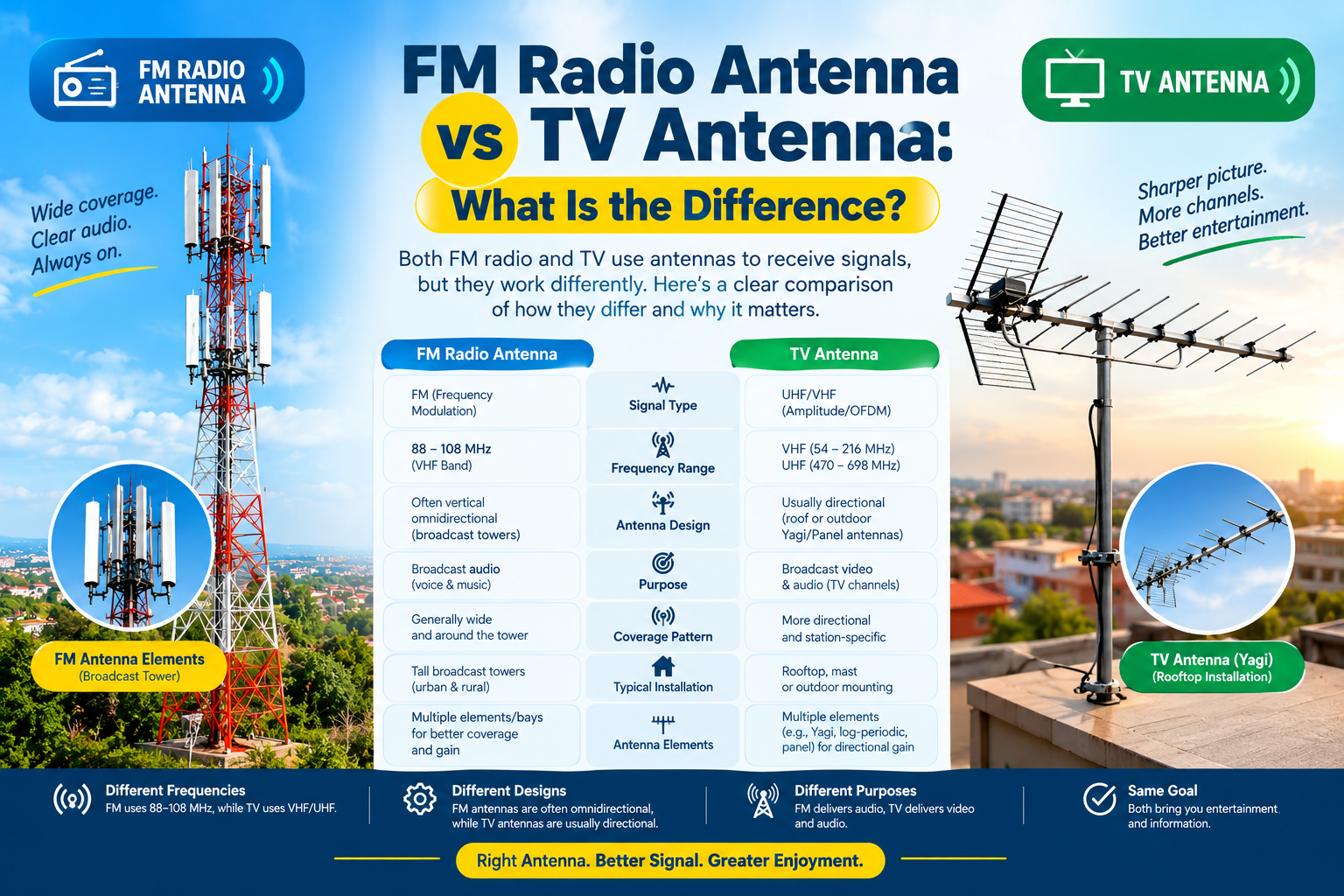
FM Radio Antenna vs TV Antenna: What Is the Difference?
FM radio antennas and TV antennas are both designed to receive or transmit electromagnetic signals, but they are not the same type of antenna system.
Although they may sometimes look similar, their frequency ranges, physical designs, polarization, radiation patterns, gain and applications can be quite different.
For someone looking at the top of a broadcast tower, it can be difficult to immediately understand what each antenna is designed to do. An FM broadcast antenna may consist of multiple vertically stacked elements or bays, while a television receiving antenna may use elements arranged along a boom.
So, what exactly is the difference between an FM radio antenna and a TV antenna?
The answer begins with frequency and the type of signal being transmitted or received.
What Is an FM Radio Antenna?
An FM radio antenna is an antenna designed to transmit or receive Frequency Modulation (FM) radio signals.
For FM broadcasting, antenna systems are engineered around the station’s operating frequency, required coverage area, transmitter power, antenna height, polarization and desired radiation pattern.
FM broadcast antennas are often installed at significant heights on radio towers because height can substantially affect the radio horizon and coverage area.
Large FM installations can use multiple radiating elements known as bays.
The uploaded engineering material explains that these elements can form an antenna array, with multiple radiating elements fed in a controlled manner to produce a desired electromagnetic radiation pattern.
What Is a TV Antenna?
A TV antenna is designed to receive television broadcast signals, although some broadcast TV transmission systems also use large professional antenna arrays.
For household television reception, antennas are commonly installed on rooftops, masts, balconies or other locations where they have a relatively unobstructed view toward the transmitting station.
TV receiving antennas can be designed for different television frequency bands and may use combinations of elements specifically optimized for those frequencies.
Common designs include directional antennas with multiple elements arranged along a boom.
FM Radio Antenna vs TV Antenna: The Main Difference
The simplest way to understand the difference is to look at what each antenna is designed to accomplish.
| Feature | FM Radio Antenna | TV Antenna |
|---|---|---|
| Main purpose | FM radio broadcasting or reception | Television signal reception/transmission |
| Signal | FM radio | Television broadcast signals |
| Frequency requirements | Designed around FM broadcast frequencies | Designed around applicable TV VHF/UHF bands |
| Typical broadcast installation | Tall radio towers | TV broadcast towers |
| Household installation | Less common as a dedicated receiving antenna | Very common |
| Radiation pattern | Can be omnidirectional or directional | Often directional for reception |
| Polarization | Depends on station and antenna design | Depends on the broadcast system |
| Antenna elements | May use multiple bays | Often uses multiple elements |
| Gain | Designed according to coverage requirements | Designed according to reception requirements |
| Main application | Radio coverage | Television reception |
The exact characteristics depend on the particular antenna and broadcasting system.
1. Frequency Is One of the Biggest Differences
The first major difference between an FM antenna and a TV antenna is frequency.
FM broadcast stations operate within the FM broadcast band. In many countries, including Nigeria, FM broadcasting is generally associated with the VHF band.
Television broadcasting can use different VHF and UHF frequencies depending on the broadcasting standard and channel allocation.
This matters because an antenna’s physical dimensions and electrical characteristics are related to the wavelength of the signal it is designed to handle.
For example, the uploaded engineering material uses 100 MHz as an FM example and notes that its wavelength is approximately 3 metres. That wavelength is important when designing dipoles, antenna bays, element spacing and feed systems.
Therefore, an antenna designed for one frequency range may not perform optimally when used for a substantially different frequency range.
2. FM Broadcast Antennas Can Use Multiple Bays
One of the most noticeable characteristics of professional FM broadcast antenna systems is the use of multiple antenna bays.
A station may have one, two, four, six, eight or more radiating elements mounted vertically on a tower.
These elements are not necessarily separate antennas operating independently.
Instead, they can form one coordinated antenna array.
A power divider and phasing network can distribute RF power to the individual bays while controlling their relative phase.
The result can be greater control over the vertical radiation pattern and potentially greater antenna gain.
3. TV Receiving Antennas Often Look Different
A typical rooftop TV antenna can look completely different from a professional FM broadcast antenna.
For example, many television receiving antennas have a long horizontal boom with multiple elements attached to it.
Depending on the design, these elements can be optimized for particular VHF or UHF channels or ranges.
The antenna may be deliberately directional so that it receives a stronger signal from the direction of the television transmitter while rejecting signals arriving from other directions.
This is particularly useful where a viewer is receiving television from a distant broadcast transmitter.
4. Antenna Gain Works Differently in Practical Applications
Both FM and TV antennas can have antenna gain, but the way that gain is used depends on the application.
For an FM broadcast station, antenna gain can be used to concentrate transmitter energy in desired directions.

Importantly, antenna gain does not mean that the transmitter has magically produced more electrical power.
A 10 kW transmitter remains a 10 kW transmitter.
Instead, the antenna system can concentrate the available RF energy more effectively, producing higher effective radiated power in appropriate directions.
For a TV receiving antenna, gain can help improve the strength of received signals and may improve reception where signal levels are weak.
5. FM Antennas Can Be Designed for Wide Coverage
Many FM broadcast stations want to provide coverage across a large geographical area.
For that reason, an FM antenna may be designed to provide approximately omnidirectional horizontal coverage.
In other situations, a broadcaster may need a directional pattern.
A directional FM antenna can concentrate RF energy toward particular areas while reducing radiation toward others.
This can be useful for interference protection, licensing requirements or geographical coverage planning.
A TV receiving antenna, by comparison, is frequently designed to point toward a particular transmitter.
6. Polarization Is Important
Another difference involves polarization.
Polarization describes the orientation of the electric field of a radio wave.
FM broadcast antennas can use vertical, horizontal or circular polarization arrangements depending on the station’s engineering requirements.
The uploaded material notes that many FM broadcast antennas use circular polarization or a combination of horizontal and vertical polarization. This can be useful because FM receivers may be used in cars, portable radios and other environments where antenna orientation varies.
Television systems also have defined polarization characteristics, but the appropriate arrangement depends on the broadcasting system and transmission standard.
7. Antenna Height Matters for FM Broadcasting
For an FM radio station, antenna height is extremely important.
A higher antenna can have a greater radio horizon because radio waves operating in the VHF range can travel significant distances when there is suitable line-of-sight propagation.
This is one reason professional FM antennas are commonly installed high on broadcast towers.
However, tower height alone does not tell the entire story.
Height Above Average Terrain (HAAT) is an important consideration in FM broadcast engineering because the surrounding terrain influences the effective antenna height and coverage calculations.
A TV broadcast antenna also benefits from elevation, but the coverage and propagation characteristics depend on the particular television frequency, transmitter and receiving environment.
8. FM Antenna Arrays Use Phasing
Phasing is particularly important in multi-element FM antenna systems.
When multiple antenna elements radiate the same signal, their electromagnetic waves interact.
If the waves reinforce one another in a desired direction, the resulting field can be stronger.
In other directions, the waves can partially cancel.
This allows engineers to shape the radiation pattern.
The uploaded engineering material describes this as the interaction between amplitude, phase and element arrangement to produce a desired radiation pattern.
This is one reason a multi-bay FM antenna is much more than simply several antennas placed on a tower.
9. Why You Should Not Automatically Use an FM Antenna for TV
It may be tempting to assume that because both FM radio and television use radio-frequency signals, an FM antenna should work equally well for TV.
That is not necessarily the case.
Antennas are designed around particular frequency ranges and electrical characteristics.
An antenna optimized for FM broadcast frequencies may not provide the desired performance across the television bands.
Likewise, a directional TV antenna designed for particular VHF or UHF channels may not be an appropriate substitute for a professional FM broadcast antenna.
The correct antenna should therefore be selected according to the frequency, application, polarization, gain and radiation pattern required.
10. FM Broadcast Antenna vs TV Antenna: Why Their Designs Differ
The physical appearance of an antenna is strongly influenced by its electrical requirements.
FM broadcast antennas can include:
- Dipole arrays
- Folded dipole arrays
- Batwing antennas
- Panel antennas
- Circularly polarized arrays
The uploaded engineering material notes that the selection depends on factors such as frequency, power, bandwidth, polarization, desired radiation pattern and tower structure.
TV antennas can also come in different designs, including directional multi-element arrangements designed for VHF and UHF reception.
Therefore, there is no single physical shape that defines either an FM or TV antenna.

11. FM Antenna vs TV Antenna: Which One Has Greater Range?
There is no simple answer.
The range of a radio or television signal depends on multiple factors.
For FM broadcasting, important factors include:
- Transmitter power
- Antenna gain
- Antenna height
- Terrain
- Frequency
- Radiation pattern
- Polarization
- Transmission-line losses
- Propagation conditions
The source material emphasizes that coverage is determined by several interacting factors rather than transmitter wattage alone.
The same general principle applies to TV reception: the quality and range of reception depend on the transmitted signal, frequency, antenna characteristics, height, terrain, obstacles and receiving conditions.
12. Are FM and TV Antennas the Same?
No.
They share the same basic electromagnetic principle: an antenna converts electrical energy into electromagnetic radiation when transmitting and electromagnetic energy into an electrical signal when receiving.
However, the actual antenna system can be very different because the applications, frequencies, bandwidth requirements, polarization and radiation patterns differ.
An FM broadcast antenna is engineered to serve the requirements of an FM radio station.
A TV receiving antenna is engineered primarily to capture television signals at the relevant broadcast frequencies.
FM Radio Antenna vs TV Antenna: Key Takeaway
The difference between an FM radio antenna and a TV antenna is not simply their physical appearance.
Their designs are determined by:
Frequency + wavelength + bandwidth + gain + polarization + radiation pattern + installation requirements.
An FM broadcast station may use multiple vertically stacked antenna bays and a carefully designed phasing network to control its radiation pattern and improve coverage.
A TV receiving antenna may use multiple directional elements arranged to receive television signals from a particular direction.
Both are sophisticated applications of electromagnetic engineering, but they are optimized for different purposes.
Final Thoughts
Understanding the difference between an FM radio antenna and a TV antenna is important for anyone working with broadcasting, radio engineering or television reception.
The most important lesson is that an antenna cannot be judged simply by its size or number of elements.
Its frequency range, gain, polarization, spacing, phase relationships, radiation pattern and installation all contribute to its performance.
For FM broadcasting, antenna height and multi-bay arrays can be especially important because engineers use them to control how RF energy is distributed toward the horizon. The uploaded material highlights that the combination of antenna elements, spacing, phase, amplitude, polarization, height and antenna design ultimately influences gain, radiation pattern, ERP and coverage.
In simple terms:
FM antenna = optimized for FM radio broadcasting or reception.
TV antenna = optimized for television broadcasting or reception.
They may both use electromagnetic waves, but their engineering requirements are different.
